A Blog-Ode
Endings:
Glasgow Improvisers Orchestra’s three-day annual GIOfest ended last night (November 30, 2024). As always, it took place at Glasgow’s CCA (Centre for Contemporary Arts), GIO’s material and spiritual home for the past two decades (and a place Tia well remembers when, in the early 1980s, it was the Third Eye Centre).
This time though, after GIO and its audience vacated the premises, CCA closed its doors until April. CCA will spend the next four months thinking about how to manage in context of a national arts funding crisis. So, the mood may have been bittersweet –
And if so, that mood was also intensified by the season. The end of November – the month poet Emily Dickinson once called, ‘the Norway of the year’, nights drawing in and, in different cultures around the world, people wait for (and, in past times, wondered about) the return of the sun.

Beginnings:
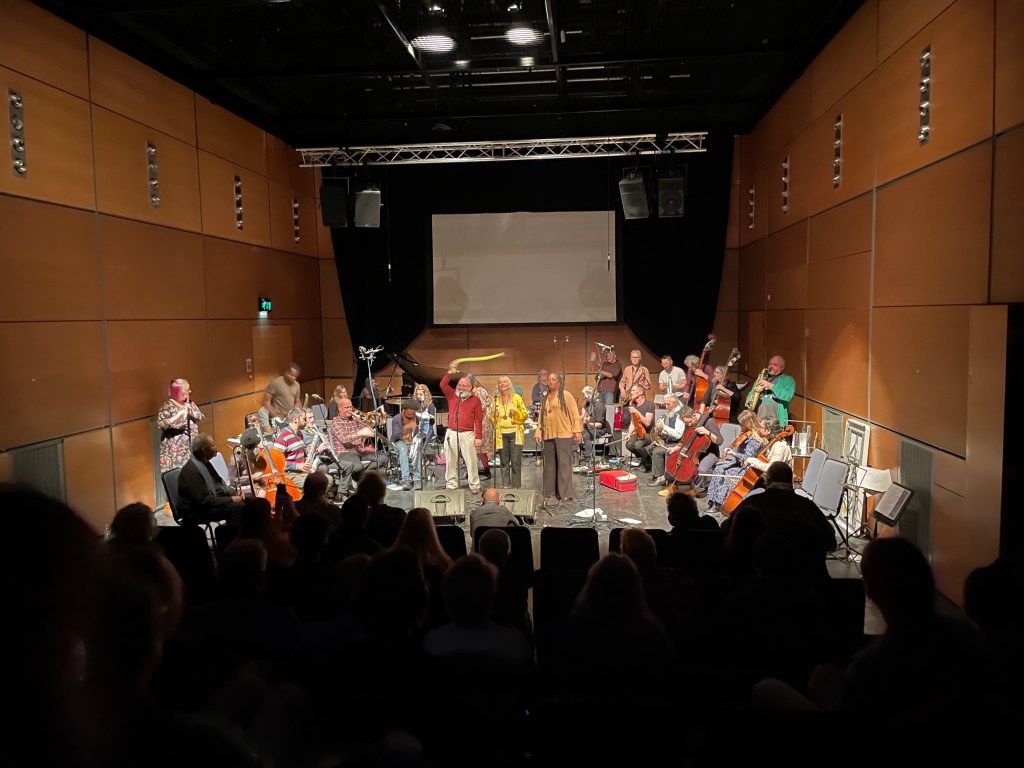
GIO is a diverse, large group, just as the musicians (residents, staff, visitors, music therapist Gary) are in Hill House. However, unlike most of the members of Hill House (the group with which readers of this blog will be familiar), probably most of GIO’s musicians are professionals – freelance/academic. They are highly versatile, highly trained, highly disciplined musical crafts-persons. GIO faces its audience in a horseshoe-shaped (open-ended, welcoming) circle (and in Douglas Ewart’s piece, Concentric, we members of the audience were called into action – we also sang as members of a kind of chorus).
Some of GIO’s members play traditional instruments, some homemade or bespoke, invented instruments. Some play amplified instruments, others acoustic instruments. Some use their voices as instruments while others move their bodies. These categories cross-cut and overlap. What happens is, in some respects, not dissimilar to what happens at Hill House: it is ‘free’ (open to the shifting split-second moment) and it is open and responsive to the sounds of others in real time.
That openness was put to test four years ago. During the pandemic, GIO pioneered methods for building an online global community. Also at that time, a small group of researchers (including Tia) began to explore those methods or ‘new directions’ in musical collaborative creativity that were taking shape within GIO online. The book associated with that research will be published in early 2025. Perspectives there overlap with themes and topics and ways of understanding music developed in the Care for Music project…
*
In contrast to the notion that live music making online was ‘impossible’ due to the ‘latency effect’, GIO (and Care for Music) took a different route. That route included – and transfigured – the so-called ‘latency impediment’. The platform was not musically ‘disabled’ but rather new-musically enabled. Practically, that enablement relied upon the ways that participants embraced new sonic, aesthetic and social possibilities afforded by the zoomesphere. That embrace led to a hybridity that continues in GIO’s work today, and to new developments, most notably, the impulse to share things that would otherwise have been invisible and inaudible, unspoken – things about home, domestic objects and treasured possessions, family members, pets, and domestic routines (cooking, for example). These things enhanced what was already GIO’s plenitude.

At the same time in Care for Music (and learning from the lessons of GIO) we (researchers) made the ‘accidental’ discovery that music therapy, or music making in a broad-church sense, could also be continued and could also afford new opportunities. So Gary, sitting at his piano a couple of hundred miles away, came to be beamed in to Hill House on a wide-screen TV via skype. It led to what we now call our ‘accidental experiment’: it opened our eyes and ears to the micro-temporal logics of practice involved in music making at Hill House. It also underpinned an enhanced and widened band-with (pun intended) of musical-participatory formats. Care-staff members began dancing and singing to signal to residents the something-special of music happening. Residents began alerting each other to what was happening musically, pointing to the TV, to each other, conducting and conducing, helping each other to make and respond to the something-special of musical occasions.
In both cases, Hill House and GIO, the ‘constraint’ of being online afforded new forms of inclusion – sonic, visual, mundane. At one point, within the context of a text-based improvisation, the late John Russel, speaking during a GIO online session said, ‘If you’ve only got lemons, make lemonade’. An improvisation/conversation ensued about all the lovely foods that could be produced with lemons. With GIO there was heightened mutual disclosure of personal concerns, events, issues, observations. With Hill House there was a wider distribution of musical agency. In both places the value and, at the time, great need and even urgency for music came to the fore. In both cases, beautiful, delicious, lemon music…

Endings:
The pandemic subsided. People returned to the wider world. Visitors returned to Hill House, GIO returned to CCA. But endings also shape beginnings and GIO is especially wondrous with endings…
*
George Lewis first introduced the topic and returned to it in a discussion panel during this year’s GIO: How, we have often wondered, is it that such a large, potentially unwieldy improvising orchestra (a very big ship as it were and one with all hands on the tiller) seems to know precisely how to end and, without pre-determination or direction? How does GIO manage to craft such seemingly perfect endings? How is so large an ensemble so agile, so able to start or stop or turn – as it were on a dime? GIO’s members will have ideas about this and so do we in Care for Music. We know that when musicians really know each other it helps. Though GIO often works with musicians it is only getting acquainted with, such as, this time, members of ICE. We know that well-honed improvisatory skills, like micro-gesturing and mutual attunement, matter tremendously. We also know that part of perceived excellence is in the eye/ear of the perceiver. But – we also know that a shared if tacit sense of occasion, symbolism, mood, topic, ceremonial significance, a sense of what feels right here, now, for this is vital if a meaningful ending (versus a coordinated stop) is to be accomplished. We saw this happen in Hill House – amongst people who are seemingly ‘without mental capacity’ but who demonstrate considerable sensitivity to musical-mood and musical occasion.
In both cases the abiding and fundamental features of human social musicality are involved. And while in GIO that musicality has been trained and honed to a very high technical level, it rests still upon something shared and upon a social virtuosity – the sense, that amateurs and professionals alike share, of what is ‘fitting’ here and now in the moment of musical action, the sense of making together a musical situation and shared occasion, the feeling-sense of what is right to do here, in the now….
*
Daniel Stern wrote about forms of vitality. Energies flowing, ebbing, quiet, slow, fast, loud, together in unison, opposing, growling, singing, short, sharp, long, smooth… When GIO, or the members of Hill House, make music together they make and inhabit different vitality forms in time and space. These forms are about sound parameters in motion, but they are also about a great deal more. What is done in the medium of sound is often linked, explicitly or implicitly, by performers and by audiences, to meaningful matters – topics, images, themes, models and templates, problems, political and social arrangements, identities…. When a visiting spouse at Hill House comments that, in music, s/he is able again to ‘meet her/his partner’ or when everyone together celebrates a resident’s birthday by singing, or when, in GIO an improvised piece is dedicated to ending a war, people are coming together in the now musically/socially, communing via music and in relation to important values and concerns. This creativity is a medium for making realities – forging relationships, social commentary, commemorating. Which is why creativity is regarded as a human right. The arts offer ways of making meaning, furnishing the world with materials, representations and symbols that we love, care about, and want to share and celebrate. That point and its consequences are well-understood in the research literatures to be a social and cultural asset and thus a set of resources for the promotion of wellbeing.
Beginnings:
At GIOfest ’24, as at Hill House, multiple realities were made, tested, and contested. In seemingly ‘small’ ways. In ways that seemed to involve performer intent, and probably in ways that did not involve intent but were discovered by members of the audience, or members of the care staff, or researchers, or visitors.
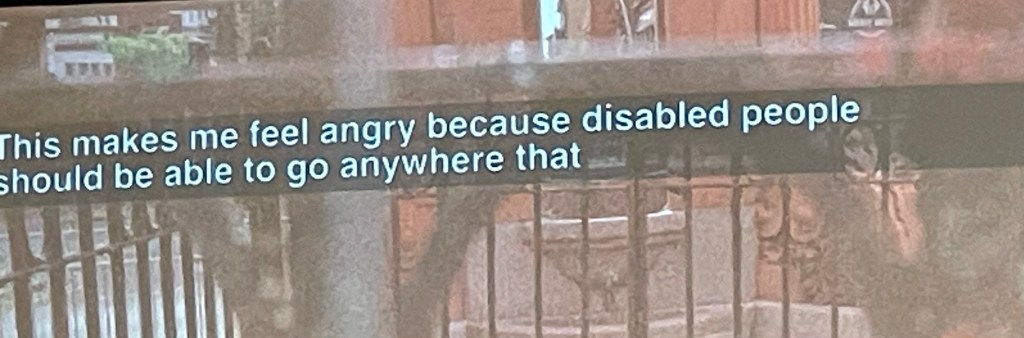
For example, during GIOdynamics, a kind of open-mic session where people new to improvisation meet seasoned improvising musicians, Maggie Nicols began with a stream-of-consciousness vocalisation on the theme of pain and the pain-alleviating power of GIO sessions. (And there are swathes of research literature out there on the theme of music and the alleviation of pain.) In a mesmerizing few moments she shook her fingers around her body, a beautiful healing ritual. In a session from Sonic Bothy, there was a protest piece – musically/politically powerful – built around inaccessible public toilets.
So too at Hill House, when a literally moving piece of music (Loch Lomond) is ‘performed’ in varying guises. It is sometimes performed because it is a beloved song. It is sometimes performed to help a resident become physically unlocked so that he can ‘march’ from the dining room to the living room where music will happen. In that performance, the music is ‘moving’ in a double sense: it is music to move to, it is, in its liberatory effect, emotionally moving when witnessed by others (spoken about in that way by members of the Hill House community). The tune is pre-composed but the rendering is improvised – and it shifts according to how the ‘moving’ needs to move, what might be ‘fitting’ or needed from split-second to split-second.
In both places, GIO and Hill House, unconventional, experimental musical tactics (amateur and/or professional) are consciousness raising – they expand the space for what we notice and are willing to entertain. And because of that, they are transformative. For example, in 2020, when Tia was playing along with GIO online as a researcher, she remembers hearing some fascinating ‘water’ noises. When the session ended and she went down to the kitchen to boil water for that night’s pasta, she ‘heard’ the sound of water anew – it was a moment of pure beauty. And washing dishes has never been the same. For example, when in Hill House members of staff witness what residents do, musically, they re-view how they understand and relate to those residents whose capabilities are allowed, in music, to shine. In both places, music making places important, ‘politics-of-experience’ matters inside the frame of ‘art’. Things that matter are given space inside music. Which is beautiful, if unconventional. Also beautiful is the space made for feeling comfortable in creating unconventionally beautiful forms. And also beautiful is the way that the senses and perception learn to notice this unconventionality as beauty.
GIO always ends a concert with a ‘free’ piece. On Saturday evening, the last piece in the last night, the sound spiralled and grew until it felt like an explosive ending was imminent. Then everything shrank back into a near whisper – which might also have been a beautiful way to end. Then the sound rose up again, a beautiful jumble or mingle of ideas or motifs. Then – it closed. If Tia heard and remembers correctly, there might have been a miniascule coda from Jer Reid’s guitar. From the audience – at least to Tia – the way the piece came to its ending seemed as if to say not so much goodbye-for-now but hello-to-what-will-come – to the next instalment of GIO’s improvised life.
*
 Care for Music