Full Circle with GIO

A Blog-Ode

Endings:

Glasgow Improvisers Orchestra’s three-day annual GIOfest ended last night (November 30, 2024). As always, it took place at Glasgow’s CCA (Centre for Contemporary Arts), GIO’s material and spiritual home for the past two decades (and a place Tia well remembers when, in the early 1980s, it was the Third Eye Centre).

This time though, after GIO and its audience vacated the premises, CCA closed its doors until April. CCA will spend the next four months thinking about how to manage in context of a national arts funding crisis. So, the mood may have been bittersweet –

And if so, that mood was also intensified by the season. The end of November – the month poet Emily Dickinson once called, ‘the Norway of the year’, nights drawing in and, in different cultures around the world, people wait for (and, in past times, wondered about) the return of the sun.

Beginnings:

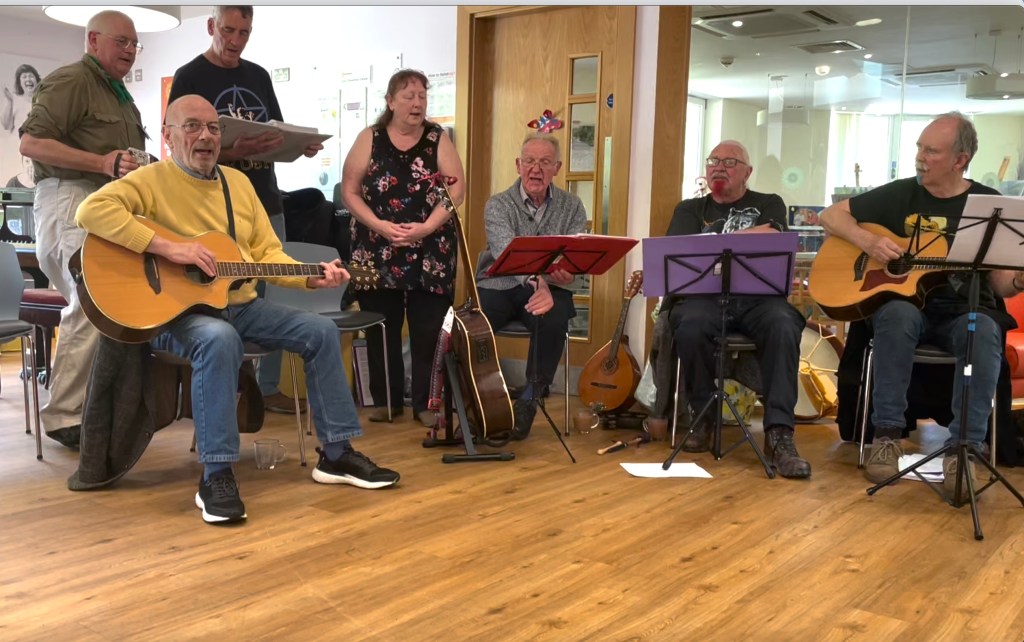
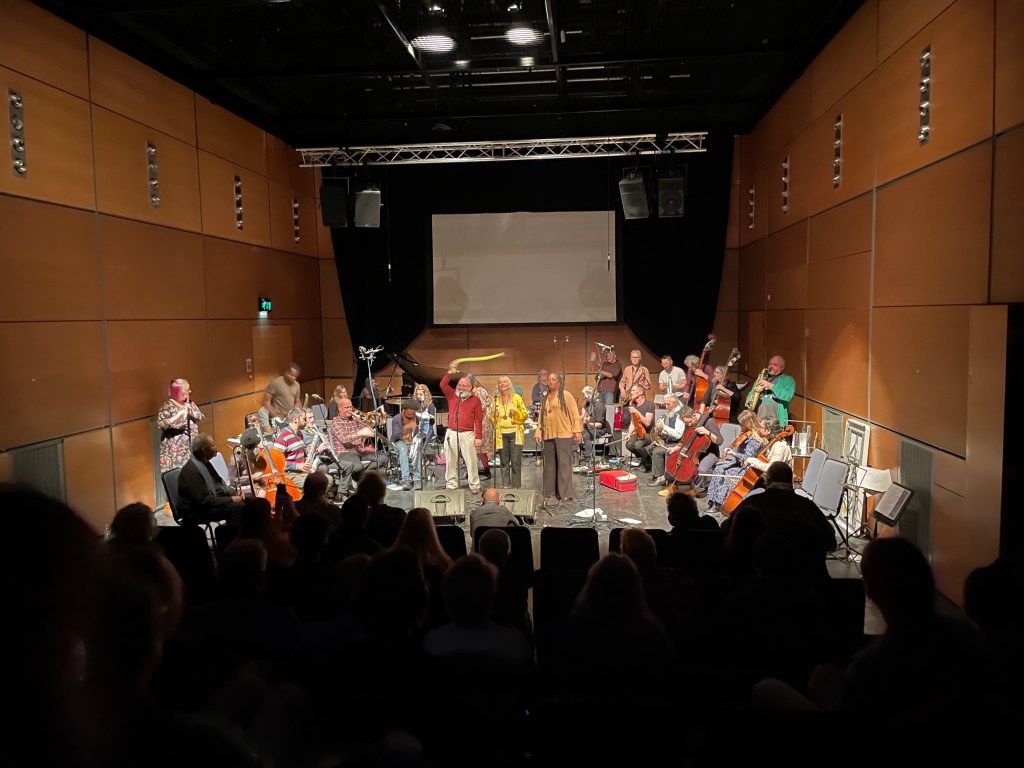
GIO is a diverse, large group, just as the musicians (residents, staff, visitors, music therapist Gary) are in Hill House. However, unlike most of the members of Hill House (the group with which readers of this blog will be familiar), probably most of GIO’s musicians are professionals – freelance/academic. They are highly versatile, highly trained, highly disciplined musical crafts-persons. GIO faces its audience in a horseshoe-shaped (open-ended, welcoming) circle (and in Douglas Ewart’s piece, Concentric, we members of the audience were called into action – we also sang as members of a kind of chorus).

Some of GIO’s members play traditional instruments, some homemade or bespoke, invented instruments. Some play amplified instruments, others acoustic instruments. Some use their voices as instruments while others move their bodies. These categories cross-cut and overlap. What happens is, in some respects, not dissimilar to what happens at Hill House: it is ‘free’ (open to the shifting split-second moment) and it is open and responsive to the sounds of others in real time.

That openness was put to test four years ago. During the pandemic, GIO pioneered methods for building an online global community. Also at that time, a small group of researchers (including Tia) began to explore those methods or ‘new directions’ in musical collaborative creativity that were taking shape within GIO online. The book associated with that research will be published in early 2025. Perspectives there overlap with themes and topics and ways of understanding music developed in the Care for Music project…

*

In contrast to the notion that live music making online was ‘impossible’ due to the ‘latency effect’, GIO (and Care for Music) took a different route. That route included – and transfigured – the so-called ‘latency impediment’. The platform was not musically ‘disabled’ but rather new-musically enabled. Practically, that enablement relied upon the ways that participants embraced new sonic, aesthetic and social possibilities afforded by the zoomesphere. That embrace led to a hybridity that continues in GIO’s work today, and to new developments, most notably, the impulse to share things that would otherwise have been invisible and inaudible, unspoken – things about home, domestic objects and treasured possessions, family members, pets, and domestic routines (cooking, for example). These things enhanced what was already GIO’s plenitude.

At the same time in Care for Music (and learning from the lessons of GIO) we (researchers) made the ‘accidental’ discovery that music therapy, or music making in a broad-church sense, could also be continued and could also afford new opportunities. So Gary, sitting at his piano a couple of hundred miles away, came to be beamed in to Hill House on a wide-screen TV via skype. It led to what we now call our ‘accidental experiment’: it opened our eyes and ears to the micro-temporal logics of practice involved in music making at Hill House. It also underpinned an enhanced and widened band-with (pun intended) of musical-participatory formats. Care-staff members began dancing and singing to signal to residents the something-special of music happening. Residents began alerting each other to what was happening musically, pointing to the TV, to each other, conducting and conducing, helping each other to make and respond to the something-special of musical occasions.

In both cases, Hill House and GIO, the ‘constraint’ of being online afforded new forms of inclusion – sonic, visual, mundane. At one point, within the context of a text-based improvisation, the late John Russel, speaking during a GIO online session said, ‘If you’ve only got lemons, make lemonade’. An improvisation/conversation ensued about all the lovely foods that could be produced with lemons. With GIO there was heightened mutual disclosure of personal concerns, events, issues, observations. With Hill House there was a wider distribution of musical agency. In both places the value and, at the time, great need and even urgency for music came to the fore. In both cases, beautiful, delicious, lemon music…

Endings:

The pandemic subsided. People returned to the wider world. Visitors returned to Hill House, GIO returned to CCA. But endings also shape beginnings and GIO is especially wondrous with endings…

*

George Lewis first introduced the topic and returned to it in a discussion panel during this year’s GIO: How, we have often wondered, is it that such a large, potentially unwieldy improvising orchestra (a very big ship as it were and one with all hands on the tiller) seems to know precisely how to end and, without pre-determination or direction? How does GIO manage to craft such seemingly perfect endings? How is so large an ensemble so agile, so able to start or stop or turn – as it were on a dime? GIO’s members will have ideas about this and so do we in Care for Music. We know that when musicians really know each other it helps. Though GIO often works with musicians it is only getting acquainted with, such as, this time, members of ICE. We know that well-honed improvisatory skills, like micro-gesturing and mutual attunement, matter tremendously. We also know that part of perceived excellence is in the eye/ear of the perceiver. But – we also know that a shared if tacit sense of occasion, symbolism, mood, topic, ceremonial significance, a sense of what feels right here, now, for this is vital if a meaningful ending (versus a coordinated stop) is to be accomplished. We saw this happen in Hill House – amongst people who are seemingly ‘without mental capacity’ but who demonstrate considerable sensitivity to musical-mood and musical occasion.

In both cases the abiding and fundamental features of human social musicality are involved. And while in GIO that musicality has been trained and honed to a very high technical level, it rests still upon something shared and upon a social virtuosity – the sense, that amateurs and professionals alike share, of what is ‘fitting’ here and now in the moment of musical action, the sense of making together a musical situation and shared occasion, the feeling-sense of what is right to do here, in the now….

*

Daniel Stern wrote about forms of vitality.  Energies flowing, ebbing, quiet, slow, fast, loud, together in unison, opposing, growling, singing, short, sharp, long, smooth… When GIO, or the members of Hill House, make music together they make and inhabit different vitality forms in time and space. These forms are about sound parameters in motion, but they are also about a great deal more. What is done in the medium of sound is often linked, explicitly or implicitly, by performers and by audiences, to meaningful matters – topics, images, themes, models and templates, problems, political and social arrangements, identities….  When a visiting spouse at Hill House comments that, in music, s/he is able again to ‘meet her/his partner’ or when everyone together celebrates a resident’s birthday by singing, or when, in GIO an improvised piece is dedicated to ending a war, people are coming together in the now musically/socially, communing via music and in relation to important values and concerns. This creativity is a medium for making realities – forging relationships, social commentary, commemorating. Which is why creativity is regarded as a human right. The arts offer ways of making meaning, furnishing the world with materials, representations and symbols that we love, care about, and want to share and celebrate. That point and its consequences are well-understood in the research literatures to be a social and cultural asset and thus a set of resources for the promotion of wellbeing.

Beginnings:

At GIOfest ’24, as at Hill House, multiple realities were made, tested, and contested. In seemingly ‘small’ ways. In ways that seemed to involve performer intent, and probably in ways that did not involve intent but were discovered by members of the audience, or members of the care staff, or researchers, or visitors.

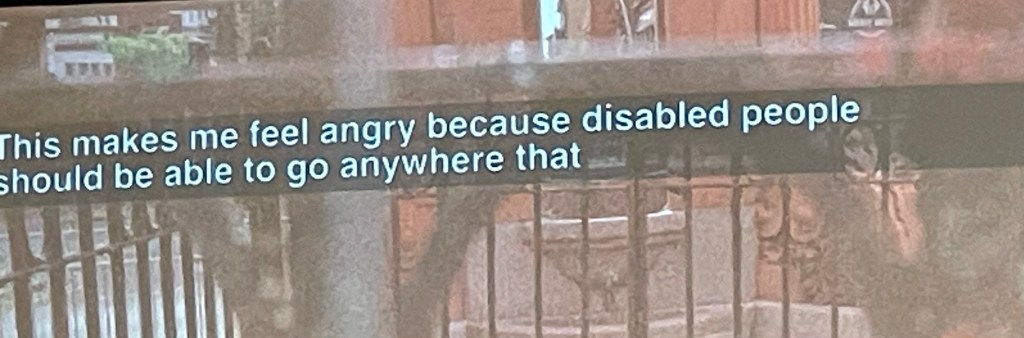
For example, during GIOdynamics, a kind of open-mic session where people new to improvisation meet seasoned improvising musicians, Maggie Nicols began with a stream-of-consciousness vocalisation on the theme of pain and the pain-alleviating power of GIO sessions. (And there are swathes of research literature out there on the theme of music and the alleviation of pain.) In a mesmerizing few moments she shook her fingers around her body, a beautiful healing ritual. In a session from Sonic Bothy, there was a protest piece  – musically/politically powerful – built around inaccessible public toilets.
So too at Hill House, when a literally moving piece of music (Loch Lomond) is ‘performed’ in varying guises. It is sometimes performed because it is a beloved song. It is sometimes performed to help a resident become physically unlocked so that he can ‘march’ from the dining room to the living room where music will happen. In that performance, the music is ‘moving’ in a double sense: it is music to move to, it is, in its liberatory effect, emotionally moving when witnessed by others (spoken about in that way by members of the Hill House community). The tune is pre-composed but the rendering is improvised – and it shifts according to how the ‘moving’ needs to move, what might be ‘fitting’ or needed from split-second to split-second.

In both places, GIO and Hill House, unconventional, experimental musical tactics (amateur and/or professional) are consciousness raising –  they expand the space for what we notice and are willing to entertain. And because of that, they are transformative. For example, in 2020, when Tia was playing along with GIO online as a researcher, she remembers hearing some fascinating ‘water’ noises. When the session ended and she went down to the kitchen to boil water for that night’s pasta, she ‘heard’ the sound of water anew – it was a moment of pure beauty. And washing dishes has never been the same. For example, when in Hill House members of staff witness what residents do, musically, they re-view how they understand and relate to those residents whose capabilities are allowed, in music, to shine. In both places, music making places important, ‘politics-of-experience’ matters inside the frame of ‘art’. Things that matter are given space inside music. Which is beautiful, if unconventional. Also beautiful is the space made for feeling comfortable in creating unconventionally beautiful forms. And also beautiful is the way that the senses and perception learn to notice this unconventionality as beauty.

GIO always ends a concert with a ‘free’ piece. On Saturday evening, the last piece in the last night, the sound spiralled and grew until it felt like an explosive ending was imminent. Then everything shrank back into a near whisper – which might also have been a beautiful way to end. Then the sound rose up again, a beautiful jumble or mingle of ideas or motifs. Then  – it closed. If Tia heard and remembers correctly, there might have been a miniascule coda from Jer Reid’s guitar. From the audience – at least to Tia – the way the piece came to its ending seemed as if to say not so much goodbye-for-now but hello-to-what-will-come – to the next instalment of GIO’s improvised life.  
*

Ray, Singer-Songwriter at Mountbatten

On poems, musical companionship, the folk scene, songs as layered creations, and the ‘cherry on top’ 

Ray, performing one of his original songs during the first Mountbatten Folk Club Session 
(Photo: TD)

“This is another one that started off as a poem,” Ray says, introducing his second original song of the afternoon. 

We are at the Mountbatten Folk Club. The Island-based musicians who convene this club have so-far offered a mix of old favourites, sea shanties and a few original songs. Ray sang one of his songs earlier. Now he’s premiering a new one, God’s Garden

“This one’s got some, la la la’s in it,” he adds. “You’ll pick it up as we go along…” Which we do, singing along with gusto, the la la la’s…

Come on now just take my hand,

I know you will understand,  

because —-

Tomorrow is a new day .

La la la la la la la

La la la la la….

*

Ray is an outpatient at Mountbatten and he’s been making music there since January. He collaborates with Fraser Simpson from Nordoff and Robbins, writing and developing his songs. Ray met Fraser through the individual and group music therapy service Fraser offers, part of Mountbatten’s Living Well Programme. Ray has a, “small portfolio of some songs that I have written in the past and need to work on.” He has three more he’s written while working with Fraser –  If I could turn the clock back, God’s Garden, and I still care. The songs are beautiful, powerful…

Ray and Fraser at the Care for Music Cabaret, performing If I Could Turn the Clock Back.
Photo: Matt White
If I Could Turn the Clock Back, by Ray with Fraser

*

As Ray told the folk group, the songs often began as poems, some of them penned a while back, some of them fresh, some of them adapted for setting to music. Ray describes how, when he first showed a poem to Fraser, a gleam appeared in Fraser’s eye and Ray knew immediately what was coming next – the suggestion that Ray should set the poem to music….

Ray’s work with Fraser at Mountbatten has rekindled a long-standing interest in music. Ray has been singing, playing the guitar and writing songs on and off for nearly 30 years. “Many years ago, I used to go to a folk club, and enjoyed singing sea shanties and traditional folk music,” he says, “I’ve really got the music bug now so there’s no stopping me.”  

The Mountbatten Folk Club 
L to R: Richard, Tony, Ray, Jackie, Eric, Alan, John
(photo TD)

Tia asked the two of them how they thought Fraser might be helping in the song-writing process, and – given that Fraser’s job is to work as a music therapist – whether this was music ‘therapy’, music making, or a combination of the two ….

Fraser said: “Because Ray was already quite proficient and independent as a musician, he did not need my help in stepping into music in the way that some people do. What I think I’m offering him is a kind of ‘musical companionship’. He and I talk about the craft of song writing and performing (such as which might be the most suitable key to sing in). I provide backup vocals and instrumental accompaniment. We review works in progress and – just as audience members do, I witness and value the creativity and sentiments expressed in the work of a fellow artist.”

Ray said: “I have always loved music, it is very important to me, both performing as well as listening to it, so it may have always been a form of therapy for me anyway, but either way I still enjoy it. I think we [Fraser and Ray] would make a good duo (Simon and Garfunkel -) The way I see it is like this – I mix the main ingredients for the trifle, i.e. the words and tune, and Fraser sprinkles on the topping and puts the cherry on top.”

*

Photo:
Gary Ansdell

The Mountbatten Folk Group

As part of the Care for Music Festival, held at Mountbatten on the beautiful Isle of Wight, we took part in a ‘knowledge exchange’ event with local musicians. 

Originally, and thinking of the very special ‘Moody Blues’ piano that’s available in Mountbatten’s John Cheverton Centre (JCC), we’d intended the event to be for Island-based pianists. We thought they might like to try their hands at playing ‘piano lounge music in a hospice or care setting’. Then we expanded this idea to include any other ‘harmony instruments’. We were thinking of things like classical guitar, or harp… To our surprise, the musicians who expressed interest in the event were, all of them, folk musicians, in particular musicians with strong interests in Sea Shanties! 

Our first thought was, “well, will Sea Shanties ‘fit’ into a care environment? Aren’t they a little – er – boisterous? Will that be too much for a hospice lounge?” We were quickly proved wrong…

*

So, we met back in March and had a really rich, fruitful discussion. It led to the notion that perhaps the musicians might play (or rehearse) outside in the summer weather on the hospice deck – so as not to be too loud inside the lounge area. Then, one of the musicians, John Bentley, who also organises the monthly folk club at Quay Arts, proposed the idea of a – Mountbatten Folk Club. A group of musicians who would visit the hospice, meet in the JCC, each taking a turn to offer a song and, over time, get to know and be known by the people and the place. John and his colleagues discussed this a bit more, John proposed it to Mountbatten, and met with Matt White, Director of Communications. The idea got the green light from CEO Nigel Hartley, and now the Club has met for the first time, last week, in the JCC. The musicians come to Mountbatten on a voluntary basis, donating their time and art. They offered classic folk songs, sea shanties, and originally composed songs. 

*

From lett to right: Richard, Tony, Jackie, Eric, Alan and John

*

The Mountbatten Folk Club is now open to anyone who uses Mountbatten’s services, to staff, family, and Mountbatten volunteers. The hope is that people from Mountbatten might also join in. And indeed, in the first session that already happened. One outpatient, a highly accomplished song writer, has already joined the group and offered his original songs. And – delightful coincidence (or perhaps not, given we are on The Island) – it turned out this man also had a long-standing interest in – Sea Shanties! 

In the middle of it all, a senior nurse came in, saw what was happening and immediately went to fetch her camera. A long conversation ensued. Discussions of ukuleles, where to learn how to play them and where to find folk groups on the Island. Tia chatted with some of the day patients and visitors who seemed very clearly to be enjoying the music. CEO Nigel Hartley came out to say hello and invited the group to play in the wards next time they visited. When the musicians turned to the audience to ask if anyone else might care to offer a song, one spritely lady piped up: I can’t sing you a song, but if I had a triangle I’d play along.

And so, Mountbatten has taken to the High Seas with exuberant, lovely, vibrant music. The musicians offered some of their original songs and we all sang along to folk classics such as Cockles and Mussels, Bob Dylan’s Girl from the North Country, Amanda McBroom’s The Rose, Ewan MacColl’s Dirty Old TownThe Isle of Wight for Me, and – it was bound to be sung – umpteen jolly verses (some of them improvised?) of What Can You Do With A Drunken Sailor.

Thank you to the musicians! And looking forward to the next time!

No kjem en vals, den vil jeg ha med deg. 

What I learn from people caring for music (by Wolfgang Schmid)

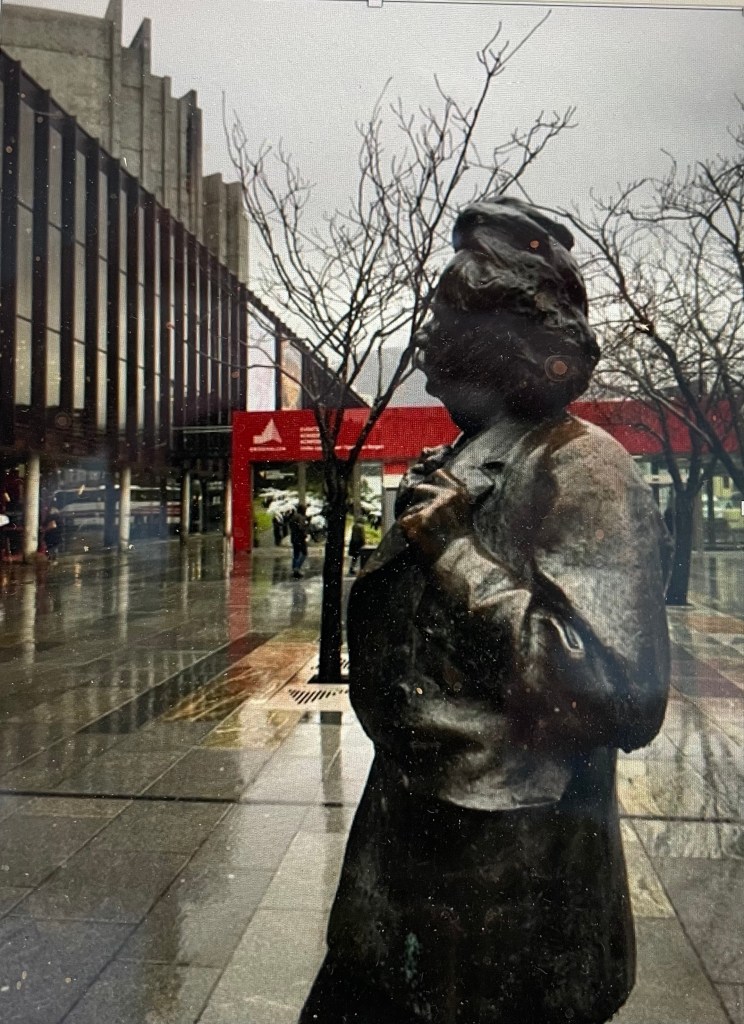
Heavy clouds, drizzle, called yr in Norwegian, and strong winds herald the beginning of spring in Bergen. One of my colleagues at the hospice once explained to me “we have two seasons in Bergen: White winter and green winter. And such weather indicates the green one”. Nevertheless, I am on my way to Grieghallen, Bergen´s big concert venue in the middle of the city, named after one of her famous sons, the musician and composer Edvard Hagerup Grieg. 

E. H. Grieg statue outside the Grieghallen in Bergen (ws)

Inside the Grieghallen, in the foyer on the first level, about 300 people have come together. A friendly, warming atmosphere with the humming sounds of people´s chatting, laughter, and pleasant anticipation fills the hall. On a stage, 60 people from the Bergen Røde Kors kor (Bergen Red Cross choir) have taken their seats. In a semicircle in front of the stage, about 250 people have gathered, most of them sitting around coffee tables with cake and coffee served. I see two TV teams positioning their cameras, and several journalists walking around taking photos. On the lefthand side of the stage, seven musicians from the Bergen Philharmonic Orchestra warm up: Two violin players, a third one with a traditional Hardangerfidel, a trumpetist, a pianist, a percussionist, and a double bass player. The choir are about 35 people living at the Bergen Red Cross home for the elderly, presenting with varied stages of dementia, and around 25 volunteers. Since 2013, the choir has its annual concert at the Grieghallen related to the project “Musikk for minnet” (Music for memory) where people with dementia and volunteers from the Bergen Red Cross sing, play and dance in concert with professional musicians from the Bergen Philharmonic Orchestra and music therapy students and tutors from the Grieg Academy. 

Later, I read on the “Musikk for minnet”-website about the project’s intention and philosophy highlighting that “people with dementia are often referred to as a uniform group. Through the project, we hope to be able to contribute to seeing the individual behind the disease.” The melody of the folktune «Å var jeg en sangfugl” (Oh were I a songbird) played on the Hardangerfidel mixes with the people´s chatting. Eventually, the choir joins and sings the tune in unison. Our colleague Fraser and the choir at the Mountbatten hospice on the Isle of Wight comes into my mind. A community of around 70-80 people with both staff, patients, and relatives. Fraser describes in his blog on these pages (“Why do we sing?”) their weekly meetings on Wednesday evening, also throughout the lockdown on zoom. There, choir members emphasize their enjoyment with singing together, lifting each other up, and jointly create an animated atmosphere of pleasure and recreation, that I also sense on this afternoon in the Grieghallen. 

*

One song follows the other. Next one is the waltz “No kjem ein vals, den vil eg ha med deg” (Now comes a waltz, I want to dance it with you). The people on the stage sing, clap, and dance. We, the people around them, sing, clap and dance. We move and are moved by the music and each other´s commitment and enjoyment. I notice others’ emotion. They notice mine. We confirm each other´s sense of this occasion, which is contained and carried on from moment to moment by and in the music.

No kjem ein vals 
Den vil eg ha med deg
Kom lat oss dansa til trekkspelmusikken
Til sola går ned

Now comes a waltz

I want to dance it with you

Come let’s dance to the accordion music

Until the sun goes down

I see people filming with their mobile phones. I see people smiling and with tears in their eyes. I see a younger woman approaching an older choir singer right in front of the stage. Is it his daughter or niece? After a sniff, he recognizes her and kisses her on the check. And then they waltz together. I have tears in my eyes and wonder, who is including whom here? What people might care for when they care for music? Questions that we in the C4M-team have discussed throughout the project. Now at the end of the project, as we sum up, these questions come up again. So, not new issues, but on this afternoon in Grieghallen, I understand that this concert tells me something simple but important related to these questions: I do not just listen to a choir performance, but also witness how people living with dementia share and invite me into their lives. Their care for music is a materialization of both agency and community. Their care for music dissolves established roles of caregiver and care recipient, of person with dementia and person without dementia. The people on the stage let us into their world, take care for all of us and make us feel welcome and included. We see, listen, are curious, learn from, and are affected by each other. We embody this in our care for music. 

                                                                        *

The philosopher Hans-Georg Gadamer suggests a person´s health and their caring for it as an active and rewarding engagement, and an original manifestation of human existence. How this can take place, be perceived and embodied, is discussed by several authors on musicking and health. For example, David Aldridge (2005) suggests that we perform our health through and in dialogue with others within a social and cultural context. We improvise our lives from moment to moment. With living as jazz, he proposes a musical metaphor for understanding human live. Like a piece of jazz, we are constantly improvising our lives to meet internal and external demands of our daily lives. Living as jazz highlights how we are and remain active, dynamic beings throughout our lives. This can continue even when we experience loss of memory, sense of orientation, or the ability to communicate with language. Also, when we are terminally ill and dying. 

The word exist originates from the Latin word existō and means to come and stand forth, be who one is, have a perception of oneself, be seen by others and interact with them, inhabit a place in the world, where one experiences meaning with their unfolding lives. On this afternoon in Grieghallen, I witness how people, how I myself, perform and perceive myself in the presence and together with hundreds of other people. We have just met each other. Now, some minutes later, we dance and sing with each other. We share some time of our lives. Freely. Intimately. Joyfully. If once only. To me, this invitation to dance is a deeply devoted and enriching engagement. An acknowledgement and celebration of the experience of being and belonging. Experiences that the philosopher Ola Sigurdson suggests, are core aspects of a person´s existential health. We are healthy, in an existential sense, when we experience that the life we live is ours. Existential health also comprises the experience and awareness for our vulnerability and the way we relate to suffering. It equips us with intentional and reflexive qualities to relate to both our ailment and health. 

*

In my music therapy work at the hospice, people with advanced stages of terminal illness show me photos, share stories and songs from their lives, are curious, humorous, sad, tired, in existential pain. Though they often have limited time, some share their imagination and thoughts, their hope, their despair. Some their struggles and strategies to cope and live their lives at the end of life. I understand this as an enactment of their existential health, a care for their own lives, including both its ailment and health. 

Espen, one of the participants in the care for music-project taught me his favorite songs. He was referred to the hospice with advanced stage stomach cancer that had spread throughout his body making it difficult for him to swallow and speak. Espen spends most of the time lying in bed. He loves to sing. In our first encounter, he tells me, with a hoarse voice and many pauses, about his lifelong passion for singing in choirs.  As a boy, he had seen a film version of an Italian opera with Enrico Caruso and Kirsten Flagstad at the Bergen cinema. He was thrilled by their voices and the performance. During the interval – the film roles needed to be changed at that time – he run home to his mother to share his excitement. But only to hear from her that the film had not been over yet, and that he had missed the second half. He remembers that this was the time when he decided to sing himself, when he joined a children´s choir. Now, some decades later in the hospice room, he still cares for music and asks me to play the song “Jeg er havren” (I am the oats). I find the text and melody on the internet and take up my accordion. First, he tries to sing himself, but it is difficult, and he lets me know. It makes him sad. I gently continue playing the song in a more improvised manner and at some point, Espen starts to conduct me with his left hand. After some time, I realize that he does not only show me the tempo and dynamic of the music, but its melody with its articulation and rhythm. Lying on his back in the hospice bed, the position that gives him least pain, he draws the words of the song with his left forefinger in the air above him. He sings the song with his hand. He conducts me as precisely as any skilled conductor. His repertoire of caring for music has expanded. He improvises and adapts it according to his very condition and the context. He acknowledges his vulnerability and limitations and at the same time reveals his enormous capacity and will for creativity and ownership. And by teaching me his song in this way, he includes me in his care for music, like the choir singers in Grieghallen did. Espen shares something important from his life with me. And he shows me not only how we can care for music together, care for each other and ourselves, but how care can be done in a broader sense. Based on a theory of selfhood consisting of multiple parts, psychologist Philip Bromberg suggests that health is the ability to stand in the spaces between realities without losing any of them. One can relate to different parts of self while being a whole person at the same time. I understand, that with his care for music, Espen still relates to himself as a singer, without ignoring the limitations set by a terminal illness. I understand that he stands in the space between these realities, performs and improvises his life, his existential health. His care for music might even help him to inhabit this space, keep it open and invite me into it. In our third session he does not want to make music himself nor listen to it. He has become much weaker and even more tired. He says: “What a pity that we do not have more time together. I could have taught you so many songs”. Instead, he asks his wife to bring all his songbooks with her from home and give them to me. This is, in my understanding, how he continues to care for music.

*

What I learn from encounters with Espen, many other participants, and from the choir singers on the afternoon in Grieghallen is that care for music comes in various forms and variations. It can be done in various places. In a hospice bed and in the foyer of the Grieghallen. Thus, not everybody wants to care for music. Music might not be equally important for all people, but many still care for music at the end of their life, seek and find opportunities to do so, and thus also nurture the experience of existential health, of living and owning their lives with its limitations and possibilities. People´s care for music provides me with some guidance for how I can support them in doing this: How to stand in the spaces between several, sometimes contradictory realities of living and dying. How to value these spaces, keep them alive and open, care for continuity and coherence that can come from them. How to care for and perform existential health. How to continue to write our own life stories.

*

The “Music for memory” concert is over. I pass the bronze statue of Edvard H. Grieg outside the Grieghallen and wonder, if and how he might have cared for music at the end of his life. Later I read in one of the biographies about him, that from 1903 he had increasing respiratory problems, and during the spring of 1907 his health deteriorated considerably. After an unusually wet summer in Western Norway, his condition became critical, and he died on 4th of September 1907 at Bergen Municipal Hospital. During the autopsy, a pulmonary emphysema was diagnosed as the cause of death. It is not recorded if Grieg had music at the hospital. If somebody has sung or played for him. His wife Nina Grieg later wrote in a letter: “Things went badly for him all summer, ever more badly. He was always freezing and had less and less breath. Energetic as he was up to the end, he practiced the piano and studied his scores in spite of increasing weakness.”

References:

Aldridge, D. (1998). Life as jazz: Hope, meaning, and music therapy in the treatment of life-threatening illness. Advances in Mind-Body Medicine, 14(4), 271–282.

Aldridge, D. (Ed).  (2005). Music Therapy and Neurological Rehabilitation: Performing Health. London: Jessica Kingsley.

Bromberg, P. M. (1996). Standing in the spaces: the multiplicity of self and the psychoanalytic relationship. Contemp. Psychoanal. 32, 509–535. doi: 10.1080/ 00107530.1996.10746334 

Sigurdson, O. (2016). Existential Health. Philosophical and historical perspectives. LIR J. 6, 8–26.


Sigurdson, O. (2019). “Only vulnerable creatures suffer: on suffering, embodiment and existential health”, in Phenomenology of the Broken Body, eds E. Dahl, C. 

The Festival!

The Care for Music Festival at Mountbatten

The Care for Music team is just back from Newport, Isle of Wight. The Project is now nearly at the end of its formal schedule (though we will continue with writing and outreach and connect to the Island Life and Death project which runs through 2024). We were thrilled that our long-anticipated Festival was finally able to happen at Mountbatten Hospice. There was an intimate seminar around project findings. There were sofa discussions around a wonderful film produced by Wolfgang Schmid and Jill Halstead. There was a tour of the hospice for Wolfgang from CEO Nigel Hartley.

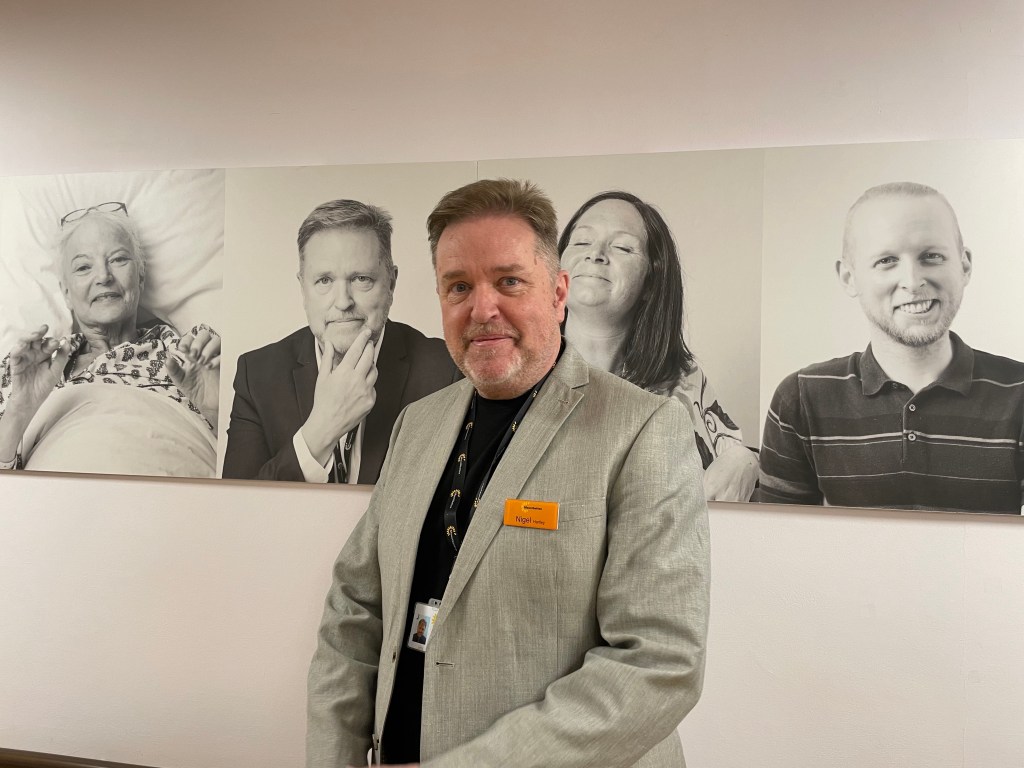
Nigel Hartley in front of his portrait in the Mountbatten and Me Exhibit
Nigel and Wolfgang in the chapel

There was a really fruitful meeting with three important folk musicians from the Island where we shared knowledge about playing ‘background’ music in caring settings. We hope that will lead to good things down the line….

And then… there was…. The Cabaret

The Cabaret evening was hosted by “The Singing CEO” Nigel Hartley. Fittingly, Nigel started off with the song Wilkommen (complete with inspired, improvised, occasion-specific lyrics):

Willkommen! Bienvenue! Welcome!
Leave your troubles outside
In here at Mountbatten, life is beautiful
The ladies are beautiful
Even some of the men are beautiful

And I’ll tell you a secret:

Some say that even the CEO is beautiful…

And now presenting the choir!
Each and every one so musical–
You don’t believe me
Well, do not take my word for it
Let’s listen!

Taking its cue, the Choir began – with Cabaret! And we were off… 

The Mountbatten Community Choir with Fraser Simpson Conductor (Photo Nigel Hartley)

Solos and ensembles from choir members and service users… The choir were ‘on fire’, as Tia said in her poem of thanks to Catering Manager Vera Mircescu, Head of Communications, Matt White, the Choir, and Choir Director Fraser during the interval.

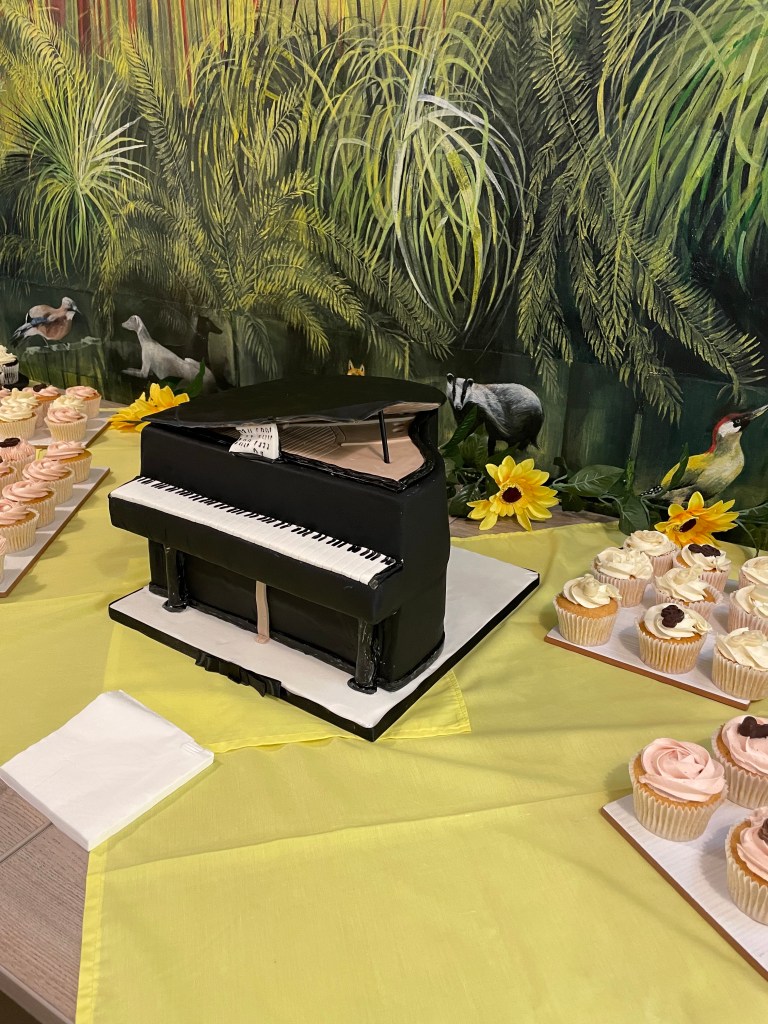
It was heartening to see how many Mountbatten volunteers turned out to help set up for the event. Café manager Jackie Davis, Café volunteer Sean, and many others gave up their time to make this special. And Donna Read, most amazing cake maker, produced this beautiful piano-shaped, delicious, cake….

The piano cake

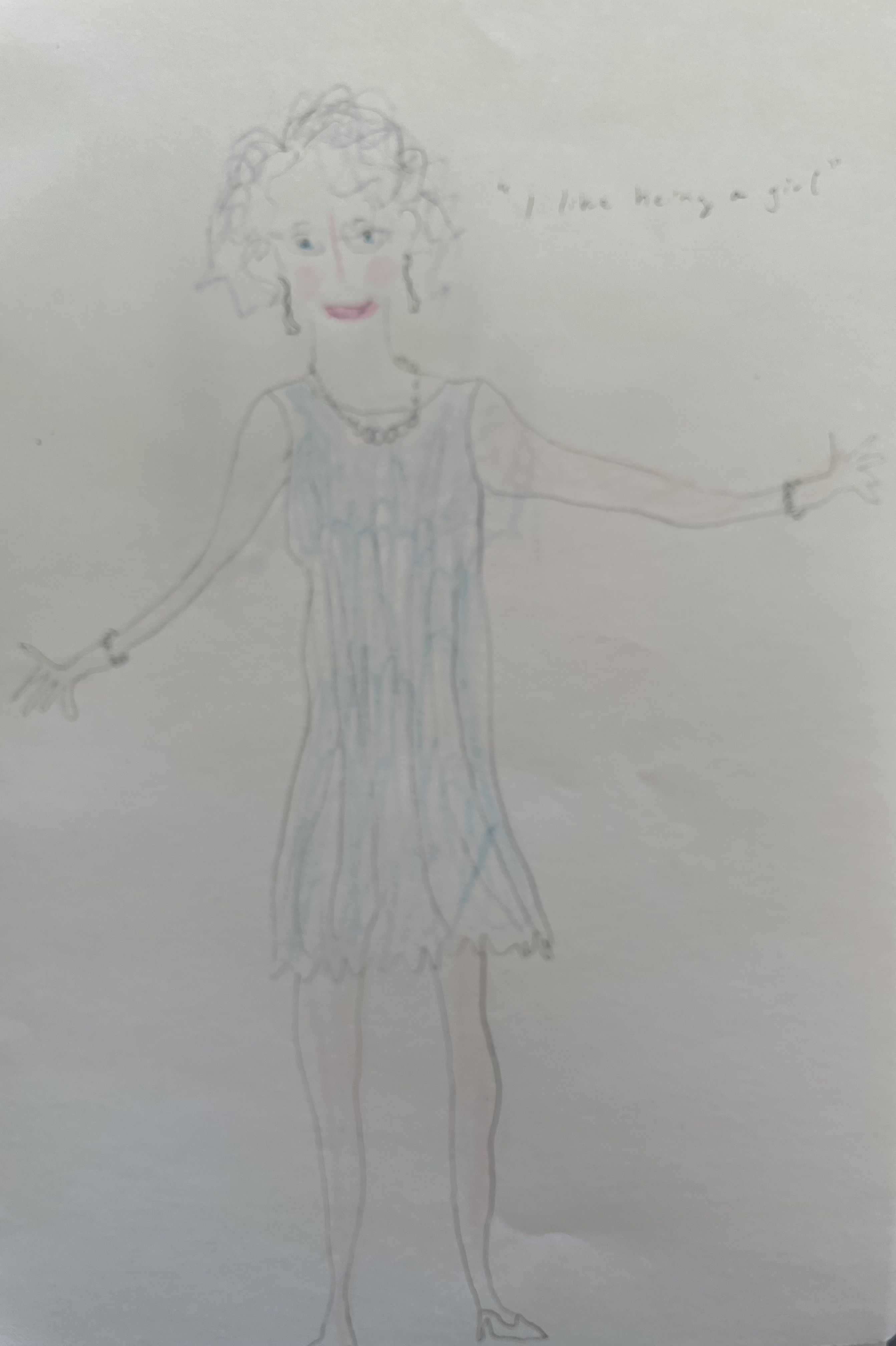
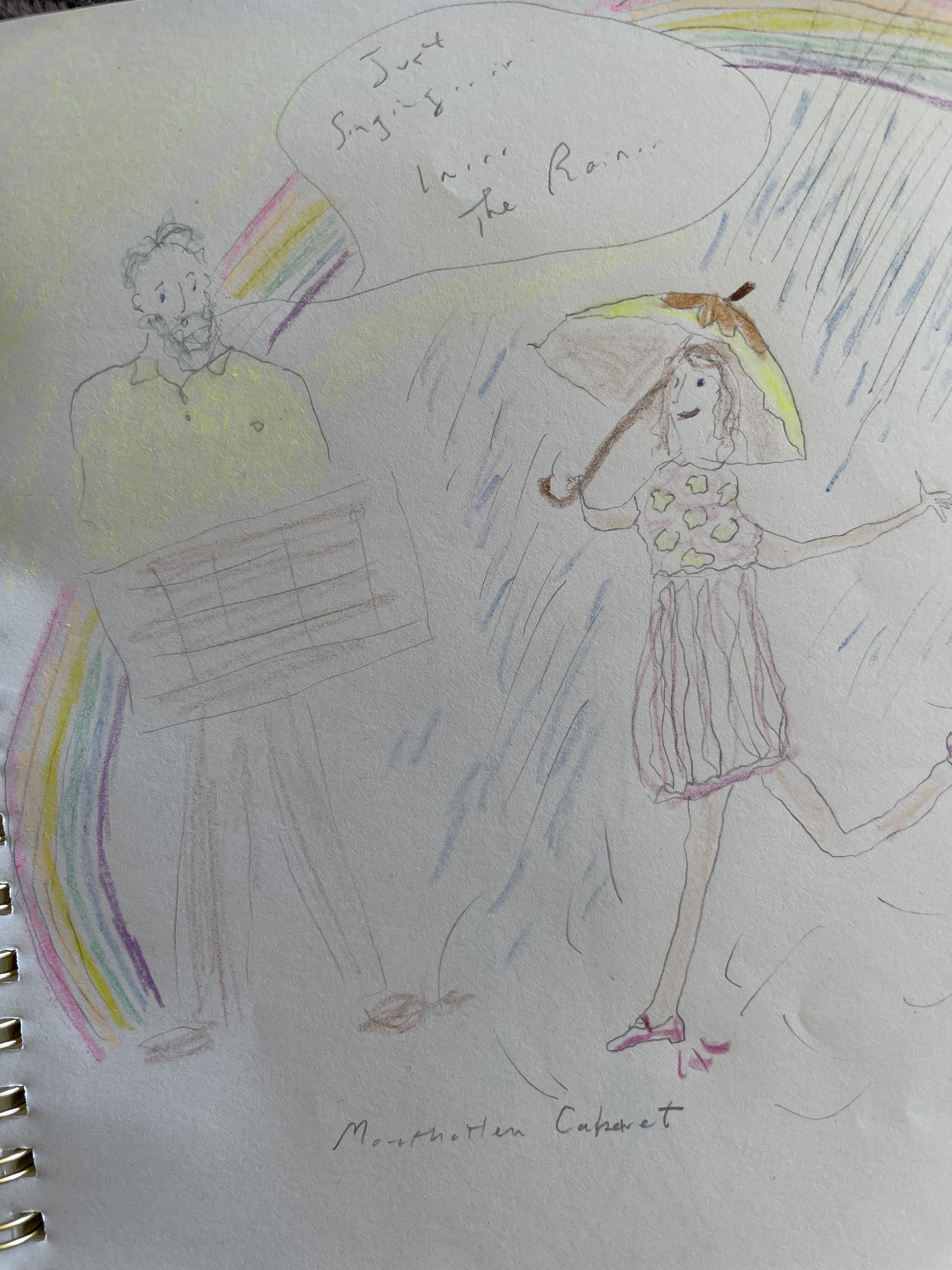
 The soloists and ensembles were amazing. Some were in costume. There were two ‘nuns’ who sang Climb Every Mountain (they had a little trouble getting into their habits but we won’t make a pun about that here…). Outside, in the hospice gardens, the rain was coming down in buckets, so what more appropriate than Singing in the Rain along with a tap-dancer complete with a Mountbatten Sunflower umbrella. Another singer – who claimed to be an octogenarian – showed off legs that a twenty-year-old might envy. She was dripping in, as she put it, ‘my bling’ when she came briskly to centre stage to announce, ‘I’m the tart of the hospice’ and then sang, with relish, I enjoy being a girl

There was a birthday to be celebrated and a surprise singing by all of ‘Happy Birthday’. There was a medley of concertina tunes. There was an original song that moved us greatly and which continues to play on in our memories (If I could turn the clock back). Two original poems and very funny were read. Another lady sang a personally tailored version of I did it my way (which was about not bothering with the housework any more – she waved a rainbow feather duster about for emphasis). 

And Fraser Simpson, beloved by all the choir, played, conducted, and supported the soloists with panache and tender loving care. The Choir sang Beyond the Sea, It ain’t Necessarily So, Downtown and Supercalifragilisticexpialidocious. Gary vamped along from the corner on piano number two. Tia and Wolfgang cheered from the audience. 

The halo’d Fraser Simpson, Conductor and Choir Leader Extraordinaire

Once again, Mountbatten has shown how it is possible to be, all at once, a vibrant cultural and community centre, a place where we can be light of heart, and a place of care for people who are dying. For the Care for Music Team, it was wonderful and inspiring. As Gary put it during the speeches, ‘if you care for music, music will care for you’.

“And the lynxes purred with pleasure”

The kantele, ‘her’ personality, and a Nordic hospice setting

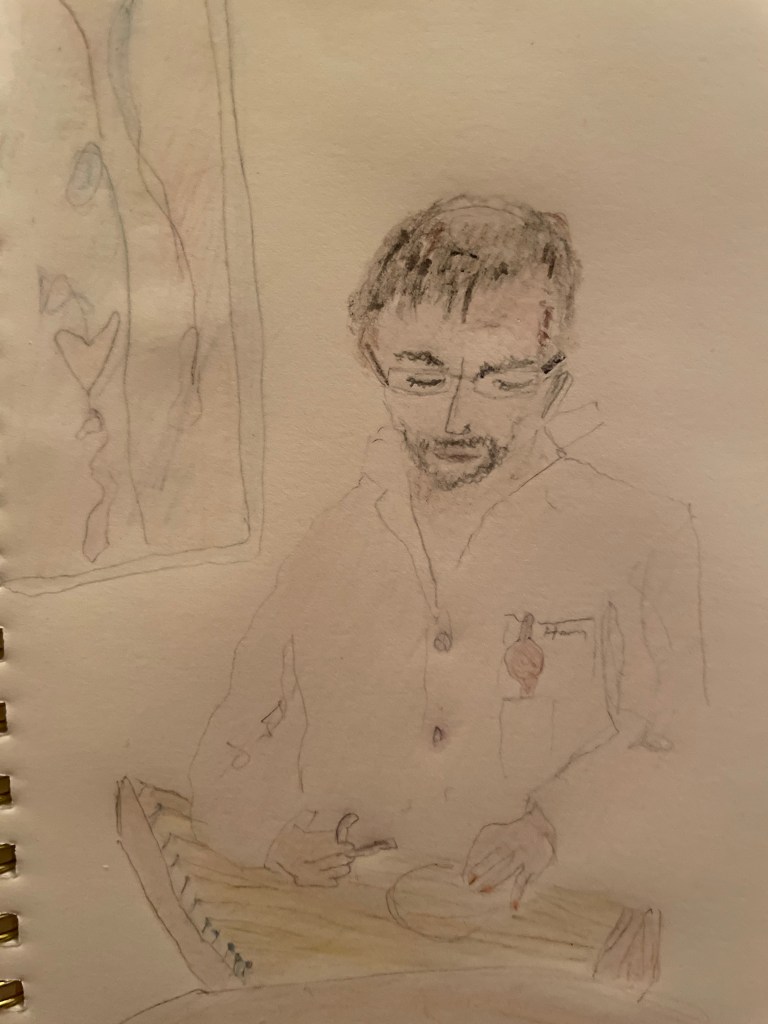
Wolfgang, tuning his kantele (drawing, TD)

Last month Tia visited Wolfgang to follow him and his kantele as they made their rounds at the hospice. It is obvious that Wolfgang’s kantele does a lot of beautiful work. Now Wolfgang and Tia (and, in fact, the kantele) are writing a book about that work – a ‘biography’ of the kantele and ‘her’ relationship with Wolfgang, and with others. What properties for soothing and healing might this type of plucked, very resonant instrument have, for whom, played how and where, by whom, and why?

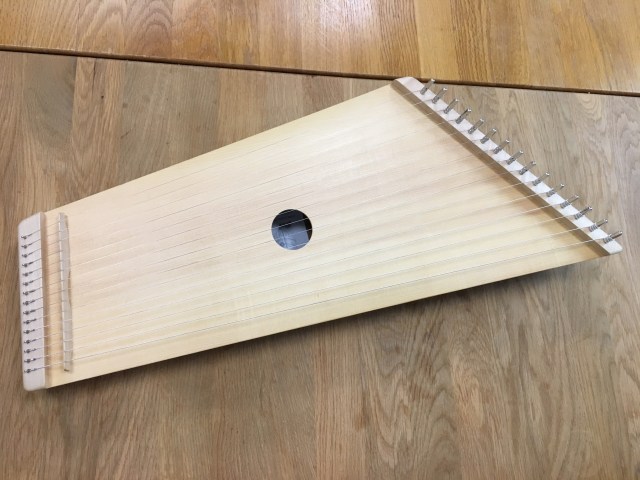
It is such a beautiful thing, with its lovely trapeze-shaped frame of pale woods (a combination of sycamore and mountain spruce). It has a row of 15 strings that can be tuned both in pentatonic and diatonic scales. According to the instrument maker in Berlin who made Wolfgang’s kantele, it is the texture of the wood from mountain trees makes the fragile instrument especially sturdy, meaning that Wolfgang can rely upon it to stay in tune. The instrument comes in different designs (size, register, number of strings from 11-25, with or without bridge). It develops its optimal sound quality over time as the wood ages and as it becomes ‘seasoned’ from being played. So kanteles do not wear out through use, but rather gain in liveliness over the years. Wolfgang’s instrument is now 12 years old. It is a warm, natural, organic object amidst the inevitable (if important) white coats and sterile features of the hospital environment that the hospice is part of…

Wolfgang, Tia, and the kantele. (Photo: Gunn Johanessen Liland)

The kantele is also very well-behaved in a hospital or hospice setting. It, or, as Wolfgang says, ‘she’, sits quietly on his lap like a well-mannered cat. She seems to knows precisely when to be silent and when to sing, and, like a cat, how to make herself very small, or very large… 

*

Culturally, the kantele enjoys a rich, poetic legacy that is familiar to many people in Nordic countries. The Kalevala recounts how the first kantele was constructed from the bones of a pike and the hair of a horse’s tail:

“All the beasts that haunt the woodlands,
On their nimble feet came bounding,
Came to listen to his playing,
Came to hear his songs of joyance.
Leaped the squirrels from the branches,
Merrily from birch to aspen;
Climbed the ermines on the fences,
O’er the plains the elk-deer bounded,
And the lynxes purred with pleasure;
Wolves awoke in far-off swamp-lands,
Bounded o’er the marsh and heather,
And the bear his den deserted,
Left his lair within the pine-wood,
Settled by a fence to listen,
Leaned against the listening gate-posts,
But the gate-posts yield beneath him;
Now he climbs the fir-tree branches
That he may enjoy and wonder,
Climbs and listens to the music
Of the harp of Wainamoinen.”

Project Gutenberg, trans of the Kalevala into English

The Sibelius Academy in Helsinki has its own fields of folk music studies where the kantele is included as an important instrument. The areas around the Baltics have offshoots, or similar instruments in kokles (Latvia), kankles (Lithuania), kannel (Estonia) and gusli (Russia). In Norway, the langeleik (or langleik, langhørpu and langspill), is a famous folk music instrument that shares some family resemblance.  In South-Germany and Austria the Zither is the counterpart to the kantele…

*

Lotte´s Zither on her commode surrounded by its audience (some of her favourite toy animals). (Photo: WS)

When Lotte hears the kantele for the first time at her bedside in the hospice she tells Wolfgang about the Zither she has at home. In her family, the Zither was played and passed along from her great-gandfather to her mother´s father, her mother and finally to her. Lotte says after her experience with the kantele music (end of 5th session): “When it comes down to it, what matters in life, who you are, you get to the core of yourself. Then you are really alone. You are really alone when you are about to die. But you have people around you who can walk the path with you. They walk with you, but they cannot follow you into death. And then to have that kind of music that you have played for me on the kantele and that made me feel so calm. I know I will be ok. I know I will manage because I have music that helps me to feel calm. To me, it is a lot about finding this calmness in myself and the ability to let go. And I believe that when the day comes that I must die, the music will carry me on and help me to find my way into death”.

Wolfgang visits Lotte and her partner two weeks later at their home place, Lotte´s condition has deteriorated and she is unrousable. Her partner tells Wolfgang that Lotte had asked him to show Wolfgang the Zither. 

*

Wolfgang and Tia have been exploring what the kantele can ‘do’ in hospice settings, the very instrument-specific ways in which it can be of help. One of those things involves the kantele’s deceptive simplicity – the fact that it can be played, and produce beautiful sounds, by virtually anyone, anyhow, anywhere: the instrument requires little strength and its strings, once tuned, simply respond. Perhaps for this reason, the kantele is sometimes called a ‘humble’ instrument and for this reason it is often taught in Finnish primary school. Indeed, once and a while, when Wolfgang is called in to a short conference with the medical team, he has entrusted the instrument to Tia who occasionally plucks it in a desultory way (Du spiller musikk, ja? someone passing by on the ward asked her last time – perhaps just being polite…).

So too, the techniques required for making the instrument sound, and produce different pitches and volumes, are clearly visible to an onlooker: the instrument is louder as you near the centre of a string (and the sounding hole), and quieter as you move away from it, and each pitch is produced from a separate string (different lengths – longer for lower pitches, shorter for higher pitches). Playing the kantele is done with the fingertips and produces a softer sound than would playing with a pick. There is (seemingly – but read on) no complicated fingering system or fretboard. So, compared, say, to a valveless trumpet where all is in the lips, and mostly hidden behind a mouthpiece, the internal muscles and the breath, the kantele is a ‘what you see is what you get’ (wysiwyg) instrument: its techniques of operation are not hidden or ‘black-boxed’ but can be seen and at least partially understood (and replicated) by a novice musician, by someone new to the instrument. In this sense, the kantele is an instrument that embodies some of the principles of participatory design.

In fact, the story is somewhat more complex…. One of the virtues of the kantele is its tremendous willingness to adapt. It can be played simply, by an untrained player (such as just described when Tia tried it out), and sound nice. Alternately, a more experienced player will know that there is more technique than meets the ear or eye. For example, as with other string instruments, to play each note in tune, Wolfgang is constantly adapting the power of plucking the strings, as a little bit too much or too little affects the tone pitch. 

sound graph, kantele in dorian mode
Kantele, Dorian mode

Despite these finer points of playing, the kantele’s apparent simplicity, the ease with which one can play it, means that when Wolfgang plays for and with someone at the hospice, there are few mysteries as to how the sound is produced. That clarity is perhaps especially important because patients in a hospice often face uncertainty – there are many things that are mysterious, and concerning. So, if they are able to see what Wolfgang is doing, they have good access to the processes by which the sounds are produced. And Wolfgang can be looking at them too, if that’s appropriate, without needing to distort his face to produce the sound. Because it is a string instrument, Wolfgang can also speak in between playing if appropriate – and how Wolfgang speaks with the people he visits is a huge part of his music-therapeutic craft (and a topic that we are continuing to explore). 

In fact, it might be most accurate to say that Wolfgang and the kantele (‘she’) are both visiting with, ‘speaking with’, the person in the bed or armchair. The kantele has, in other words, a nice, open personality but is not an ego, she does not ‘insist’ on being heard or on being the centre of attention. These traits mean that, if a patient (in a bed) should wish to try playing the instrument for themselves, it is possible, it requires minimal effort and it is pleasing. Low-threshold… Which is not, of course, to say that the kantele will suit everyone – no one size instrument fits all; not everyone will care for music, or care for music at this time, here, now…

On this topic, Wolfgang, Tia, Gary and Fraser have written earlier, describing one patient, Mia, then in the last weeks of her life, who borrowed Wolfgang’s kantele over a weekend, wrote a song and performed that song for her visiting siblings (who made a video recording that they then allowed to be shared with the Care for Music Team).

Mia introducing her concert and her song to her brothers

In addition to that scholarly article, Wolfgang wrote a “very short short story” from the kantele’s perspective, about ‘her’ encounter with Mia. His work is part of our methodological strategy of using poetic and artistic media as a mode of ‘gentle methods’ of research enquiry. Here is an excerpt:

She lifts me up and sails me through the air above her bed. Her fingers broken through the chemo caress my strings. Her soft, delicate fingertips find a melody. And I feel the vibrant joy in both our bodies…”

*

There are further and at present, more hypothetical, questions – what, if anything, might be the importance of kinaesthetic hearing + seeing? Watching, as the tense strings are plucked, listening to each tone reverberate, hearing each tone linger and eventually fade back into the silence of a hospital or hospice room… Does the instrument afford a particular set of metaphoric understandings? For example, of how pain might be managed, what pain might be like, how pain might also ‘fade’? A listener might make a connection between the notion of taut nerves or muscles, of those tense things being stretched and allowed to relax, to vibrate, resonate… And perhaps through that to ease, to be more quiet than before… Then there is the sight of that gentle activity – how the instrument is played… Again this might not be a link that all or even many might make, but it might be easier to make this link given the material properties of the kantele, than, for example, the trumpet (absolutely glorious as that instrument is). 

*

On one of the days Tia visited with Wolfgang there was a strong wind blowing outside the hospital. From inside one patient’s room, they could hear the trees at the base of the mountain rustling and see them as they were blown back and forth. The hospital room, therefore, was not as quiet as it usually would have been. It was almost, Tia thought, as if the kantele had become an aeolian harp. Later, when she mentioned this to Wolfgang, she learned that he had taken careful notice of the natural sounds and was working with them, weaving the wind into his playing. As Tia sat in the corner of the room (we do not have permission to discuss the reactions of the person we were with at this time and so will not say anything about him/her), Tia felt completely at peace, attentive to the wind which the almost inaudible kantele served as a counterpoint. She reflected on how, if she were in that hospice bed, it might well be these kinds of sounds that she would most long to hear…

                                                                        *

It might seem that we are romanticising the kantele – and perhaps we are. But we hope what we are also doing is enquiring into the manifold, micro-crafted features of how ‘she’ (the instrument) comes to be empowered to act – on each, specific and individual, occasion. So, for example, when Wolfgang introduces the kantele to a person for the first time, he plays some music to let the person hear ´her´ sound; from there, they decide themselves if they want to hear more – or not. (There are only a few do not wish to hear the kantele´s sound at all, and only a very few who do not want Wolfgang to continue after he first plays). Once decided, Wolfgang asks the person to find a comfortable position in their bed or armchair, close their eyes if they want, and then have not more to do. Wolfgang adds that he might adapt the improvised music to the person, relate to their breathing and overall condition. But not necessarily. 

After a first improvisation (2-3 minutes), Wolfgang will pause, listen, and give space to the person to respond or remain silent. In this pause some people give feedback about the music and tell that it is comforting, calming, soothing, that they have less pain. Or that the music should be different: Calmer, more lively, softer, louder…  Some people just ask for more kantele music. And some have their own ideas and tell Wolfgang how they wish to continue, for example, here, first Daniel and then, Anders: 

Daniel: After the first improvisation where Daniel gets to know the sound of the kantele, he suggests that he might conduct Wolfgang´s playing. His wife and son are present in the hospice room. Daniel sits in his bed and initially moves his fingers, subsequently his hands and arms to tell a dramatic story with music. The kantele’s music follows Daniel´s gestures and movements: Single soft tones accumulate and increase, and lead to waves of energetic soundclusters and tremoli that gradually recede again. In this performance, Wolfgang plays the instrument as soft and as loud as he can. To match the dynamic sound qualities of Daniel´s sweeping arm movements, Wolfgang helds the instrument with its back towards his stomach, so that the instrument´s body and his body complement each other resulting in higher volume.  

Michaela, Daniel´s nurse on that day, approaches Wolfgang after the session to say, that the atmosphere in the room was quite different after Daniel´s performance. She could sense emotional resolution and belonging, qualities that had not been there before. Wolfgang and Daniel get to see each other a second time at Daniel’s home. Together with Daniel´s son, they choose music for his funeral. 

Anders: The third time Anders meets Wolfgang and the kantele he watches them attentively. He recalls his experiences with the kantele music from the week before and tells that he had seen himself as a little boy flying away with the music. 

During the first improvisation on the kantele in this session, Anders dreams away and flies again with the music. During the second piece of improvised music, he sees himself above a beach, but is this time distracted by the kantele music. It is too energetic and rhythimcal. So, Wolfgang asks Anders to tell him more about the place (beach) where he wants to be and then adapts the music accordingly, finally plays music that is calmer and more open in it´s melodic structures.

That wasn’t easy”, Anders says after the music. “I am going to die”.

Anders tells Wolfgang more about the vision he had while the kantele was playing. He was on a sailing boat off to the sea. His family had gathered at the beach, but not all of them were there. So, he turned into an eagle and flew back to them. He wanted to say goodbye to everyone.

Anders pauses for some time. Then asks for some more music and suggests: “Maybe it goes better with more rhythmical music?”

He closes his eyes and again turns into an eagle in his imagination while the music is on, flies back to his family at the beach to make sure that they are all together and ok.

This is difficult. But I managed to say goodbye this time”.

Some thoughts later, from Wolfgang´s research log: “Anders shares his experiences and needs openly. He employs and accommodates the kantele music to fit with his ideas (a kind of ´flying carpet´, a vehicle for his last journey?). He imagines how it will be, what needs to be in place for him to be able to let go. And seems to prepare himself for ´how´ to do this. The kantele music shelters, contains and expresses his resources and his vulnerability.”

*

“…Now he climbs the fir-tree branches
That he may enjoy and wonder,
Climbs and listens to the music
Of the harp of Wainamoinen.”

*

Over the past years, the instrument´s role in interdisciplinary care and pain management at the hospice has become more distinct and recognized. Here at the hospice, music and the administration of analgesics are combined as often as this is possible for practical reasons, acknowledging that a person´s pain experience is individual and complex, and needs to be met in its physical, emotional, social and spiritual dimensions. It is linked to a developing collaboration between physiotherapy and musictherapy and that is contributing to the holistic approach to care at the hospice. As Wolfgang’s medical colleagues see it, the kantele contributes to a balance between providing patients with a fundamental embodied experience of, on the one hand, activation (physiotherapy) and, on the other, rest (music therapy). That balance is often hard to achieve when someone is in immense pain or experiencing side effects of medication. As Sara, a specialized palliative care nurse, put it when speaking to Wolfgang:

 “Du spiller på andre strenger” (“you play on different strings”).

On ‘Late’ Learning and Creativity

Who Cannot Learn?

Wolfgang, Fraser, Gary and Tia are delighted that our article on ‘late’ learning is now published in a Special Issue of Scuola Democratica, Edited by Anna Lisa Tota and Antonietta De Feo. Other articles in this rich SI address Disability and Arts Education, Prison Theatre, Epistemology, Educational Research Training, Teaching Sociology through social aesthetics, the School as a Temporary Exhibition Space, and two book reviews, one on A. Bayley’s Posthuman Pedagogies in Practice: Arts Based Approaches for Developing Participatory Futures (Palgrave MacMillan 2018)and one on Tia’s book on Hope in the same issue, the latter by Lia Luchetti.)

We were excited to be able to present three detailed, person-centered case studies (one from each of the three research sites – a care home and two hospices), to use some of our Care for Music drawings for the first time in an academic article, and to work with amazingly helpful editors and very helpful critical peer reviewers too. The process was wonderful and we look forward to future dialogue on the topic of who can learn, what is creativity, for whom, when and where, and with what consequences.

The list of references from the article is here:

Ansdell, G. and Pavlicevic, M. (2010), «Practicing ‘Gentle Empiricism’: The Nordoff Rob- bins Research Heritage», Music Therapy Perspectives, 28 (2), 131-9.

Antonovsky, A. (1987), Unraveling the Mystery of Health: How People Manage Stress and Stay Well, San Francisco, Jossey-Bass.

Becker, H.S. (1982), Art Worlds, Berkeley-Los Angeles-London, University of California Press.

Featherstone, K. and Northcote, A. (2020), Wandering the Wards: An Ethnography of Hospi- tal Care and its Consequences for People Living With Dementia. London, Routledge.

Freire, P. (1970), Pedagogy of the Oppressed, London, Continuum Press.

Delamont, S. and Atkinson, P. (2001), «Doctoring Uncertainty: Mastering Craft Knowledge», Social Studies of Science, 31 (1), 87-107.


DeNora, T. (2014), Making Sense of Reality: Culture and Perception in Everyday Life, London, Sage.

Groce, N. (1985), Everyone Here Spoke Sign Language, Cambridge, MA, Harvard Univer- sity Press.

Lave, J. and Wenger, E. (1991), Situated Learning: Legitimate Peripheral Participation, Cambridge, Cambridge University Press.

London, M. (2021), The Oxford Handbook of Lifelong Learning (2nd edition), New York, Oxford University Press.

Mehan, H. (1988), «Educational Handicaps as a Cultural Meaning System», Ethos, 16 (1), 73-91.

Tia DeNora, Wolfgang Schmid, Fraser Simpson and Gary Ansdell

Mukerji, C. (2009), Impossible Engineering: Technology and Territoriality in the Canal du Midi, Princeton, NJ, Princeton University Press.

Schmid, W. (2017), «Being Together – Exploring the Modulation of Affect in Improvisa- tional Music Therapy with a Man in a Persistent Vegetative State – A Qualitative Single Case Study», Health Psychology Report, 2 (5), 186-92.

Schmid, W. (2013), «A Penguin on the Moon: Self-Organisational Processes in Improvi- sational Music Therapy in Neurological Rehabilitation», Nordic Journal of Music Therapy, 23 (2), 152-72.

Suchman, L. (1987), Plans and Situated Actions: The Problem of Human-Machine Commu- nication, Cambridge, Cambridge University Press.

Tota, A.L. and Hagen, T. (2016), Routledge International Handbook of Memory Studies, London, Routledge.

Witkin, R. (1998), Adorno on Music, London, Routledge.


Wood, S. (2020), «Beyond Messians Birds: The Post-Verbal World of Dementia», BMJ Open Medical Humanities, 46, 73-83.

Rachel Verney, An Ode of Thanks

Rachel, Gary and Tia at the end of a long meeting looking at video data

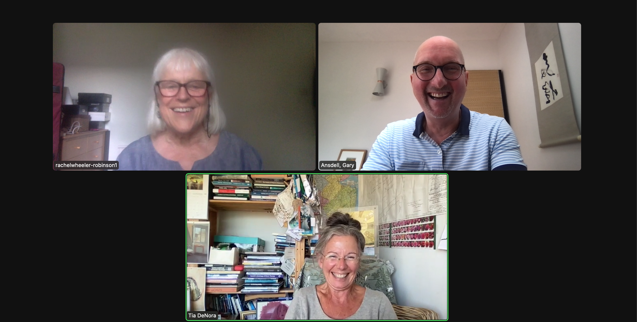
We’ve been meeting with our Project Consultant, Rachel Verney, on and off throughout the analysis stage of Care for Music. Rachel was trained by Paul Nordoff and Clive Robbins and has had vast experience working as a music therapist, and training many, now quite senior and well-known, music therapists. When we meet, we look at data together and test ideas, interpretations, hunches…. 

Rachel was Gary’s teacher and now she’s Tia’s teacher too. She has an uncanny eye – and ear. Today we looked, repeatedly, at video footage using the stop-and-discuss technique. We were interested in whether, without any prompting or background, Rachel might see and hear what we thought we’d noticed. Or whether she would not! (Which makes it a bit of an adventure, and therefore all-the-more interesting.) 

Some people might call this cross-validation, which of course it is, but it is also much more. We have learned and are learning from Rachel how to develop our micro-observation skills, she offers fresh thinking of what might be happening and – equally vital – she has a congenital aversion to jargon which we have found more than once has stopped us in our tracks. Today we spent a lot of time ‘unpacking’ the term, ‘to musicalize care’. We decided it involved a number of different things – an attitude toward possibilities, practices that draw activities into music’s parameters, careful listening (including embodied listening, such as ‘listening with your fingers’) and careful response, and openness to being changed. We also got deep into micro-matters such as ‘was that a fermata or did it simply sound like a held-note because it was being sounded over an inverted chord?’. In the example we were listening to this isn’t just a ‘musicological’ matter as these micro-musical details potentially influence the responses and actions of the people in the scene we’re looking at (or not! This was the nub of our conversation). We also learned more about the benefits of, as Rachel puts it, ‘optimistic listening’, that is listening for the best possible outcomes so that we know, perhaps, how better to produce them musically-socially in real time practice. Thank You Rachel.

Gary Ansdell and Mercedes Pavlicevic Receive 2022 European Music Therapy Confederation Award

The Care for Music Team is very pleased to announce that Care for Music Investigator, Gary Ansdell and his research partner at Nordoff Robbins, Professor Mercedes Pavlicevic have received the European Music Therapy Confederation Award for 2022. The Conference meets every three years.

Gary and Mercedes in Sandane (when working on Stige, Ansdell, Elefant and Pavlicevic, 2016)

We are very happy to be able to include Gary’s message of thanks to the conference here:

“My heartfelt thanks to the European Music Therapy Confederation for this honour. Also on behalf of the late Mercedes Pavlicevic and her family, who will be thrilled to hear this news. As most of you know Mercedes died in 2018 – it’s just past the 4th anniversary of her death. We still miss Mercedes the person of course, but her legacy is clear now, and was well celebrated at the World Congress in 2020 in South Africa. Two key qualities came out of us thinking about Mercedes’ professional work: courage and imagination. She was certainly a disrupter of professional holy cows… but she did this with lightness, intelligence, and kindness. 

It’s really special that this award is presented here, as Mercedes had important connections with Edinburgh. But of course she also influenced music therapists and other musicians worldwide – in Africa, the Middle East, Europe. She was a real international.

I had the pleasure and privilege of working with Mercedes over more than 20 years. Mercedes as ‘disturber’ had a low tolerance of lazy ideas, practices, and people! A lot of our work together was in the early days of developing the Community Music Therapy as an idea and international movement. I sometimes describe Community Music Therapy as a can-opener rather than a can. Our aim was to open up music therapy again – to help music therapists work best in their local, cultural contexts. Getting beyond ‘one size fits all’ models and practices.

Those qualities that were key to Mercedes and her work – courage and imagination – are also key to Community Music Therapy and its shoogle. I’ll finish with the slogan that we often used: Follow where music and people lead… That usually works!” 

***

Congratulations to Gary and Mercedes, whom we miss dearly. You have inspired us in all we do.

You can also read Gary’s essay on the links between Mercedes’ artwork and her work in music therapy here: https://www.up.ac.za/media/shared/728/sketches-of-mercedes-ansdell.zp191301.pdf

Reference:

Stige, B., G. Ansdell, C. Elefant and M. Pavlicevic. 2016. Where Music Helps: Community Music Therapy in Action and Reflection. London: Routledge.

“Do you think they sang at the Last Supper?”

Easter at Hill House

Music Session, Residents & Gary, Hill House

The day I start working at Hill House I ring the bell and to my surprise a priest answers it. She just happens to be near the door, getting ready to do a communion service for a small group of residents in a side room. When I announce myself as the new music therapist, she quickly enlists me to play guitar for the hymns. 

The priest comes only monthly, and the residents at this home are a mix of Christian and Jewish, whilst many of the carers are young Muslim women. I wonder how the spiritual needs of people can be cared for here. 

*

Just before Easter Ruth, one of the residents, unexpectedly asks at the end of the music therapy group session “Do you think they sang at the Last Supper?”. This is a woman who lives with dementia, says very little, and looks confused if you speak to her. Her question remains in the air, so she answers it herself: “As we’ve been so happy I think we should go and cook a chicken!”. 

*

Eve comes up to me at the end of the session. She looks into my eyes and struggles to get the words out, but there’s something she needs to say to me: “Thank you for coming here… music… it’s more important than food for us”. 

*

As a visiting music therapist, and working there as a practitioner prior to Care for Music, I wasn’t at Hill House enough to answer my question about how the care home did or didn’t manage the spiritual needs of its residents (our ‘data collection’ has been conducted online because of the pandemic). But over the years there I’ve had glimpses of how music can be part of what could be thought of as spiritual experience for residents, staff, families. The vignettes I’ve included above were a reminder to listen and look carefully at what residents may not be able say or express anymore in conventional ways, but sometimes convey in poetic forms, images, or gestures. Also, to be conscious of what music ‘points towards’ for some people, which we might call the spiritual, soulful, or transcendent – however variously these terms are understood and ‘performed’. 

But this remains a key issue of course: how is ‘the spiritual’ understood and talked about today, especially in late and end of life care settings, and in a multi-cultural, multi-faith context? So, I’ve been reading around this area again, and thinking back to the history of how music therapy has slowly began to talk about spirituality again. Some readers of this blog may remember the Oxford World Congress in 2002 where Nigel Hartley and colleagues bravely put both community and spirituality back onto the map for serious professional discussion. Both areas had been taboo in music therapy for too long but, we argued, should be talked about again since they were clearly present in clients’ and therapists’ experience. Since 2002 there’s been a gradual development of both practice and serious thinking and research in this area, especially within later or end-of-life care (to mention just the sources I’ve been reading – Hartley 2012; Goodhead & Hartley 2018; Tsiris 2018; Notarangelo 2021).  

In Spirituality in Hospice Care Nigel Hartley is helpfully candid in his chapter about the ‘definition problem’: “…the concept of spirituality, for me, is messy, slippery and confusing, but also intriguing, occasionally inspiring and often totally consuming” (p.24). Nigel probably speaks here for many of us, if we’d admit it! A priest’s chapter in the same book writes wearily about spirituality as a ‘giant conceptual sponge’, soaking up almost anything. Another way we could say this is that words like spirit(ual) or soul(ful) are ‘placeholders’ – they don’t point to anything specific, but are a way of pointing towards the intangible, and possibly unsayable. In contrast to the materialist vocabularies of medicine (‘broken bone’, ‘blood clot’,) they don’t indicate things or even processes. They are “unwords” in Iain McGhilchrist’s (2021) nice term – words that place-hold that which doesn’t have a physical, spatial, or even temporal reality in the usual sense, but still matters, and still has traceable consequences. What a spiritual or religious vocabulary gives is a way of talking and thinking that directs our attention to people and their experiences in a non-ordinary way. Spirit-talk, soul-talk, transcendence-talk affords a particular quality of attention, witness, and care towards whole persons and their relationship with the seen and the unseen, which we might otherwise overlook if we only allow physical, psychological, or social phenomena to be ‘real’. Cicely Saunders, the hospice pioneer famously talked about ‘total pain,’ which included ‘spiritual pain’. But where is this? What vocabulary and practices express and address it? 

*

In my book How Music Helps the sections work through the various areas where music does just this: helps recognise people fully, build identities, relationships, community. The logical end-point to this sequence emerged as how music often helps with experiences of ‘transcendence’ – with how music can sometimes take us beyond the self, the area of spirituality. I realised that throughout the book I’d assembled a certain spiritual vocabulary because this was the only set of words and ideas that could describe this particular aspect of musical experience that people so regularly tell us about as music therapists.

As we now work through the data of the Care for Music project we’ve allowed ourselves to be attracted to those ‘facets’ that most shine out. Spirituality is one of these, and an initial approach to data analysis has been to trace the vocabulary of the field notes that best describe this facet. In a thousand pages of practice log, the following ‘spiritual’ terms occur (in ascending order of prevalence): Epiphany = 2; Religion/Religious = 3; Faith = 3; Transcendence = 5; Consolation = 5; Suffer(ing) = 7; Pray(er) = 7; Existential = 11; Vitality = 13; Beyond = 19; Purpose = 20; Ritual = 22; Presence = 23; Soul = 24; Meaning = 26; Value = 27; Community/communitas = 36/36; Quickening = 37; Witness = 48; Spirit(ual) = 49; Hope = 58; Beauty = 75; Attention = 92; (En)joy-joyful = 199; Love = 305; Life = 324.

It’s worth looking closer at the incidents and experiences that elicited these ‘tags’. This blog isn’t the place for a long discussion on an elusive subject, but here are some inconclusive notes and questions on aspects of music and spirituality that we’re currently thinking about in relation to Hill House and the people who live and work there:   

  • Non-verbal spirituality: Many of the residents of Hill House are ‘post-verbal’ for various reasons. But they often retain lively embodied and symbolic ways of communicating and creatively expressing themselves. How does music help with this alternative articulation of ‘the spiritual’? The vignettes above from Susannah and Eve show how there’s often a symbolic or poetic allusion that communicates aspects perhaps of their past and present religious or spiritual practice or understanding (for example, music as ‘spiritual food’ for Eve). Other times it’s simply the non-verbal sense of ‘something beyond’ within a fleeting moment of musical connection. 
  • Ritual and communitas – The Christian communion service I helped with during my first day was a conventional religious ritual of great value to those who attended. But are the music therapy sessions themselves a ritual? My logs over the years record many sessions where mood, energy, social relationships and more have been transformed: “Conviviality – helped by the tea coming halfway; warmth and mutual contact and appreciation between residents, between staff and residents. And lastly, hope and fun.” Is this what Victor Turner called ‘communitas’? – a dynamic, liminal, performative state of ‘betweenness’ that groups can experience as transformative; “that sense of union with others which is a large part of the aim of ritual and a major concern of religion” (Edith Turner).
  • Spirit and Soul – A family member once said, “It’s a portal to people’s spirits”, whereas the manager one day said, “Thank you, my soul’s been warmed” after she joined a group. The tendency for spirituality to be a ‘giant conceptual sponge’ indicates there’s room for more phenomenological differentiation. The data depicts manifestations of both ‘spirit’ and ‘soul’; inevitably a subjective and poetic distinction, but interesting. In short: spirit lifts, animates, quickens, whilst soul descends, deepens, colours, connects. How does music work differently with spirit and soul? 
  • Suffering, Beauty, Joy – A spiritual lens can allow seemingly incompatible aspects of experience to relate. Beauty, rather than being sentimental, stands out in relation to that which is fragile, near the end, feeling anything but beautiful. Joy stands out amongst pain, sadness and suffering. In music these opposites and incompatibilities can and do exist. Here’s an excerpt from the current, project, log:
    • “As ever the music’s a vehicle for ‘something else’ happening there: I know this sounds vague, but I mean it’s to do with the dimension of ‘spirituality’, broadly conceived: joy, quickening, connection, appreciation… Life in a word. Perhaps I think this because it’s Ash Wednesday, and I’m just about to sing in the cathedral service… but also earlier I was thinking about the paradox in a place like Hill House between the spiritual aspect of musicking… and the everyday shit of their lives – for residents and carers (quite literally, the work is endless toileting and feeding).”
    • “Yes, there are dark times…  but also light ones too. We need sadness too… It makes it real” (Elinor)
  • Hope: The daughter of a resident once said, “I was getting down about coming here, and how mum is… and then this afternoon’s music has given me hope again…”. As Tia has written about in her recent study of this aspect (DeNora 2021), hope is a dream we carry, often amid situations which are difficult and feeling hopeless. Musicking often generates, carries, and lends hope to people and situations at Hill House.
  • Life – “You bring life to us” Eve says. ‘Life’ comes top of the list of ‘tags’ (324), with the paradox of this being in a situation where people are near the end of their lives. Residents, staff, families point out how music often shows up the life still in people, and the particular quality of life that flares in musical communication, often referred to as ‘quickening’ in the log – which is far more than physical stimulation. That ‘life’ is seen as a spiritual aspect perhaps connects to the growing trend for what the theologian Don Cupitt (1999) calls ‘the new religion of ordinary life’ where “life” itself is celebrated and sacralised. Of all the reports that we witness on how music helps in Hill House it’s perhaps how it ‘brings back the life’ in people that is most notable – and perhaps the most intangible spiritual phenomenon? 

*

Lastly, a confession: I left out ‘love’ when I first searched for key ‘spiritual terms’ in the data. It turned out to have 305 references! Love is such an everyday word that we may forget (like me!) that it’s at the core of almost all spiritual traditions and endeavour. Along with Hope and Faith there is Love as Caritas – or ‘charity’ in the traditional biblical translation. It’s also increasingly acknowledged in the literature on dementia care (Gerrard 2019). I then remembered the quote that I put at the very end of How Music Helps, when one of my interviewees, Rachel Verney, talks about Nordoff and Robbins’ ‘music child’ concept: 

The idea of the ‘music child’ was an attempt to say how there’s something about people which is whole and healthy and which responds to the call of music. But it’s also hope, and it’s love, and it’s beauty, and it promises the impossible. It’s absolutely a spiritual concept, there’s no question.(p.294)

This kind of love isn’t primarily eros (though that can be there in music too), or philia as close musical companionship and community, or even agape – the unconditional love of the New Testament. Instead it’s perhaps what Mark Vernon (2008) explains as a further form of love characterised by the Greeks – kalos, which he links to wellbeing. Kalos can mean ‘beauty’ but in the sense that it orientates you to what you love, and through this love towards a desire for the good, and to live rightly and happily. Music doesn’t of course make people love, but it helps with this. The anthropologist John Blacking (1973) wrote of his long-term immersion in the musical culture of the Venda of South Africa: “Problems in human societies begin when people learn less about love […] The hard task is to love, and music is a skill that prepares man [sic] for this most difficult task” (p.103). 

*

I’m about to leave Hill House when Susannah takes both my hands begins a speech to me, says how lovely the music is, how sensitive my touch is… and then she tries to say more and her speech muddles. She stops, pauses, looks me straight in the eye and says “Love… Love… Love…”.

References

Blacking, J. (1973). How Musical is Man? University of Washington Press. 

Cupitt, D. (1999). The New Religion of Life in Everyday Speech. SCM Press. 

DeNora, T. (2021). Hope: The Dream We Carry. Palgrave Macmillan. 

Hartley, N. (2012). Spirituality and the Arts: Discovering What Really Matters’. In: M.Cobb et al. (eds) The Oxford Textboook of Spirituality in Healthcare. Oxford University Press. 

Gerrard, N. (2019). What Dementia Teaches Us About Love. Penguin. 

Goodhead, A. & Hartley, N. (2018). Spirituality in Hospice Care. London: Jessica Kingsley.

McGilchrist, I. (2021). The Matter with Things. Perspectiva Press. 

Notarangelo, A. (2021). ‘Ecological Awareness in Practice: Spirituality, Community Health, and the Possibilities of Music Therapy’. Health & Social Care Chaplaincy Vol.9, no.2 pp298-314. https://doi.org/10.1558/hscc.41473

Vernon, M. (2008). Wellbeing. Acumen. 

Tsiris, G. (2018). Performing spirituality in music therapy: Towards action, context and the everyday. Unpublished PhD thesis: Nordoff-Robbins/Goldsmiths, University of London.