We (Gary and Tia) are exploring the uses of poetry in ethnographic research. This is different from writing, for its own sake, poetry about what happens in, or outside of, the field. This is also different from seeking to share ‘research poems’ with readers or listeners as part of a process of ‘public engagement’. We are – some might say, overly – cautious about writing poems expressly for these purposes. We think that they can become:
….so artificial, Such a deliberate step backwards To create an object…
By contrast, poetry is part of our desire to develop ‘gentle’ research methods and to contribute to conversations around what ‘gentle’ methods might mean and do. ….
We think social research often makes too-hasty a leap to interpretation, to attribution of character and causality. We think, by contrast, there is much to gain and learn by being ‘gentle’, by which we mean taking time with a scene, staying ‘with’ a person or group, and zooming in to examine a moment (perhaps listening repeatedly to the micro-features of a sound recording). We want to slow the research process down. And we think poetry has a role to play in this slowness.
We’re interested in where attempting the poem-writing process takes us, what it might reveal (to us) about our research sites and research relationships, and how poetry might draw out new and potentially important features of what we are seeking to describe and understand. We are equally interested in how writing poems, because of the demands that literary forms make of their makers, might not only draw out, but also potentially traduce or over-write the greater richness of what is otherwise there to be noticed.
Which has led us to ask, to what extent is it possible to harness the dynamics of poetry writing so as to lead to further reflections about a scene or site or set of relationships. If all forms of writing involve compromise, if all of them produce an ‘object’ then writing in any genre –a letter or research report, field notes, novels, and poems – can be dangerous. Dangerous – and also necessary, if we want to place our thoughts in a shared domain, to capture what we want to know about and dwell upon. The question is then how to tell about and how modes of telling all have consequences… How, then, to use the various lenses that writing affords to learn more – in this case about people, music and care.
I started working as a music therapist at Hill House four years ago. Almost every week since there has been live music for a couple of hours on a Thursday afternoon. It involves anyone who’s there at the time: residents, family members, staff coming in for ten minutes, or simply dancing through to the kitchen. The sitting room turns, gradually, from sleepy to lively. There might be unexpected musical participation as people sing, dance, play instruments, or just tap a foot. Sometimes you’ll see people mouthing the words to a song. Residents singing to their next-chair-neighbours. Staff noticing things they’d never seen residents do before. In a rare moment of intimacy the wife of one resident will hold hands and sing with her husband who, once-eloquent, no longer has spoken language. These afternoons are inevitably convivial, joyful. The atmosphere lightens. There is a sense of presence– people coming back, as it were, to themselves, and coming together in a powerful way.
Gary doing a music therapy session via Skype during Lockdown2
Then the music stopped. Covid-19. In March 2020 almost all care homes in the UK were in crisis. Family visits and social activities ceased immediately as care homes valiantly adapted to the new situation to protect their vulnerable residents. I sat at home feeling helpless – thinking about what was happening at Hill House, worrying about the residents I’d grown so fond of, and wondering if the situation would spell the end of music therapy sessions.
Three weeks later, the manager asked if I would continue the music sessions by Skype. My first thought was ‘this will be impossible!’. In those early days of the pandemic musicians all over the world were rapidly discussing online how to manage music therapy, music teaching, or music performance now. The talk was of synchronous and asynchronous timing – facing the simple fact that on the internet current technological limitations meant that we see quicker than we hear, so there’s a significant time-lapse that makes making music together in real-time challenging, and often unsatisfactory. I wondered how I could possibly manage this when the people I was making music with also had perceptual and cognitive challenges due to their age or disability…
But, of course, I tried. The first week care workers organised some residents in a row in front of the large TV in the living room that was linked-up to Skype, and I sat in front of my laptop miles away, singing and playing guitar and piano. To me, the first session felt chaotic and hopeless: the signal kept dropping out, and I felt I was singing to myself as I watched some of the residents I knew staring at the TV screen in what looked to me like puzzlement. But then a moment… Saul looked up at the TV, moved his arm upwards with the musical phrase, waited, and as I sang a downwards melody he gradually lowered his conducting arm along with my voice. Musical connection!The rest of the session was messy, probably unsatisfactory to everyone, but I’d learned something crucial: it waspossible.
I’ve now done 22 of these Skype sessions. It’s helped me re-think how what it can mean to have a ‘successful session’. Often these sessions are messy, sometimes confused (with all of us equally confused as to what’s going on!). My vision of the room is limited (mostly I see just the front of the room). We see each other in two dimensions. The internet signal is intermittent. Of course, residents are often sleepy or not feeling up for it – though this is no different from when music was live.
Despite the difficulties, there are moments when it clicks. When people seem to look right through the TV, right through the physical distance that separates us. There is mutual learning and support as all of us adapt to the constraints. Residents are singing to each other again. They are pointing to the TV screen, alerting each other to what’s going on. Staff are singing with the residents, dancing with them, dancing with each other. Staff members say that in these tough times when they are stressed and over-worked, just five minutes of doing live music with the residents and with each other makes all the difference. “It’s therapy for us” is what they have said.
For the Care for Music Research Project, dealing with these constraints has led to what we are beginning to realise constitutes a series of ‘accidental experiments’. Facilitating musical connection in extremishas opened up new ways of thinking about what it means to be musically connected. It has put the spotlight on many skills and capabilities we did not know the residents had. It has highlighted their care for music, and their desire to sustain musical encounters. And it’s opened up new questions and topics – specifically how any ‘successful’ musical event is a collaborative, and multi-media, multi-sensory, effort, something immensely richer than an ‘intervention’. So now in our research around this topic we’re asking the question, what might this time of social distancing teach us about musical connection and how can what we learn be feed back into music making once – hopefully – we can be together again in the same room? To be continued…
The theme of this World Federation Congress is Polyrhythms of Music Therapy. Nice. We recorded our contribution for the conference on Friday. None of us are too clued up with zoom so it’s been a learning curve. But in a way, that made it more fun – at least in the recording and we laughed a lot in between trying to get the timings sorted and the key information conveyed. The Congress website is here and will be updated regularly until the actual dates – July 7 & 8 – when the presentations can be viewed (and we’ll be on hand afterward to for discussion). https://www.wfmt.info/resource-centers/events-center/world-congress/
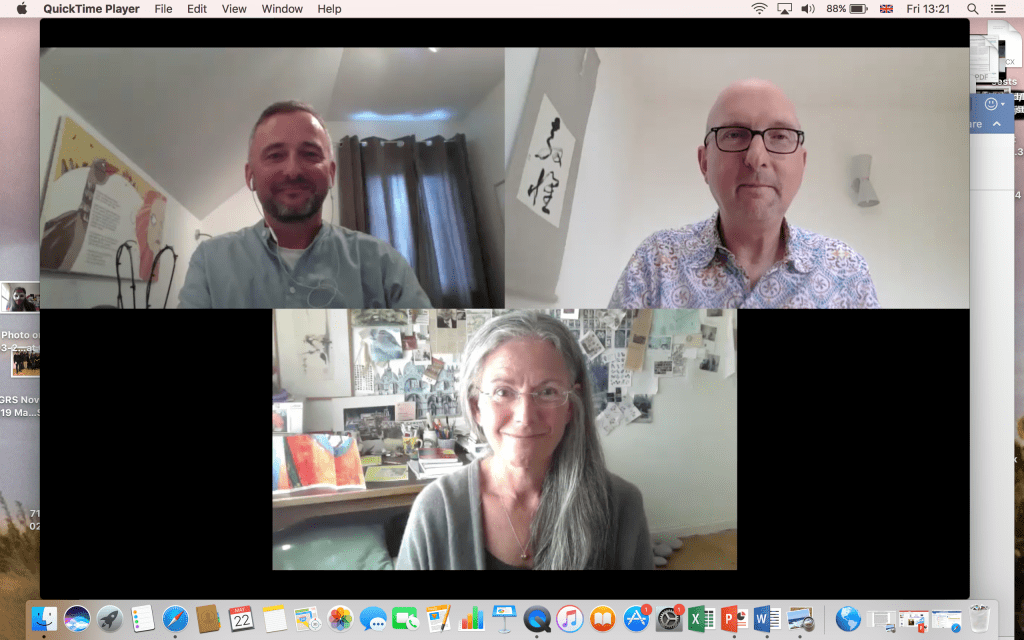
Wolfgang Schmid (Voss), Gary Ansdell (Norwich), Tia DeNora (Exeter), on a Zoom Learning Curve
Music is there for us. It keeps us company. It puts us in mind of others. It can help to shift our mood.
So much uncertainty. Inevitable anxiety. Much in upheaval. The NHS enduring tremendous strain. And all of us, if we are lucky, at home (that is, if we have homes). And something new that doesn’t come naturally – social distancing.
This is where music can help. We can’t go to the theatre or sing with our choir or jam with our band. It is not possible to visit museums. To just hang out in parks or on street corners. Or to attend church services. But music is still there for us and it offers consolation.
At this time we’re thinking of our favourite music, registering, savouring and remembering the different times in our lives when we first encountered certain songs or works, the people that music helps us to recall (those who are living but also people from our past who may have died). Even in isolation music can help to kindle connections, memories and moods.
Health/illness experience has been a rich seam for poetry and there are some wonderful precedents – we’re thinking of Auden’s famous ‘Care Home’ poem, Larkin’s ‘The Old Fools’ or ‘The Building’ or ‘Ambulances’, Sharon Old’s The Father, and all those beautiful, bitter-sweet ‘cancer poems’ which you can read about here Cancer Poetry, by Ian Twiddy, 2015 MacMillan.
We are very interested in how poets employ language in ways that (in the old fashioned sense of the poet) make experience and both of us are amateur poets (hopefully not quite of the Vogon variety…). And so we are interested in how artistic researchers create literary forms as part of a project of stimulating public discussion about issues such as dementia and end of life.
Our project departs from this tradition. While we are interested in how poetry (and the arts in general) can be used to promote public engagement with issues, we are even more interested in how poetry can be used as part of reflexive practice in research, forresearchers.
While Tia has used formal poetry as a kind of ‘imaginative method’ for exploring the ways that a particular family (her family) responds to the experience of dementia, Gary has for a while now been writing little fast-composed poems about people and events in his work as a music therapist. Sometimes this is to remember people after they have died. It helps him process the sadness associated with the loss of music participants. Other times it is to capture a ‘telling’ moment, to think about the wider world of relationships and happenings as it is refracted in a ‘grain’ of interaction and exchange. In both cases, the poems are responses to things they’ve noticed about others, and about themselves in response to others.
The use of poetry here places a minute detail – an event or experience – inside a frame. That framing in turn helps to hold a moment, to consider things in detail and to consider modes of description as they have power over the shape and content of what we describe and then come to remember and know. Dwelling in this way can help draw to our attention things we want to know and analyse that our other methods of data ‘collection’ cannot address. And it can alert us to some of our presuppositions and reflex practices of ‘writing up’.
Writing ethnography is, as Paul Atkinson has observed, inevitably a literary endeavour. So too is all science writing – scientific enquiry and scientific praxis has, in other words, a poetics (back to Goethe). If every literary foray packages/repackages, arranges, highlights, translates, traduces, constitutes, and constrains its subject, then thinking about what comes out when we write within a genre, style or form calls attention to the social contract we make with the words we use, and the words that use us. And so we are asking ourselves – what emerges when we ‘tell’ about the field in short, ‘poetic’ bundles of words (as opposed to field notes), how might these bundles, because of their particularity, sensitise us to things that we might not otherwise have noticed and – this is the key – with what kinds of consequences for those involved?
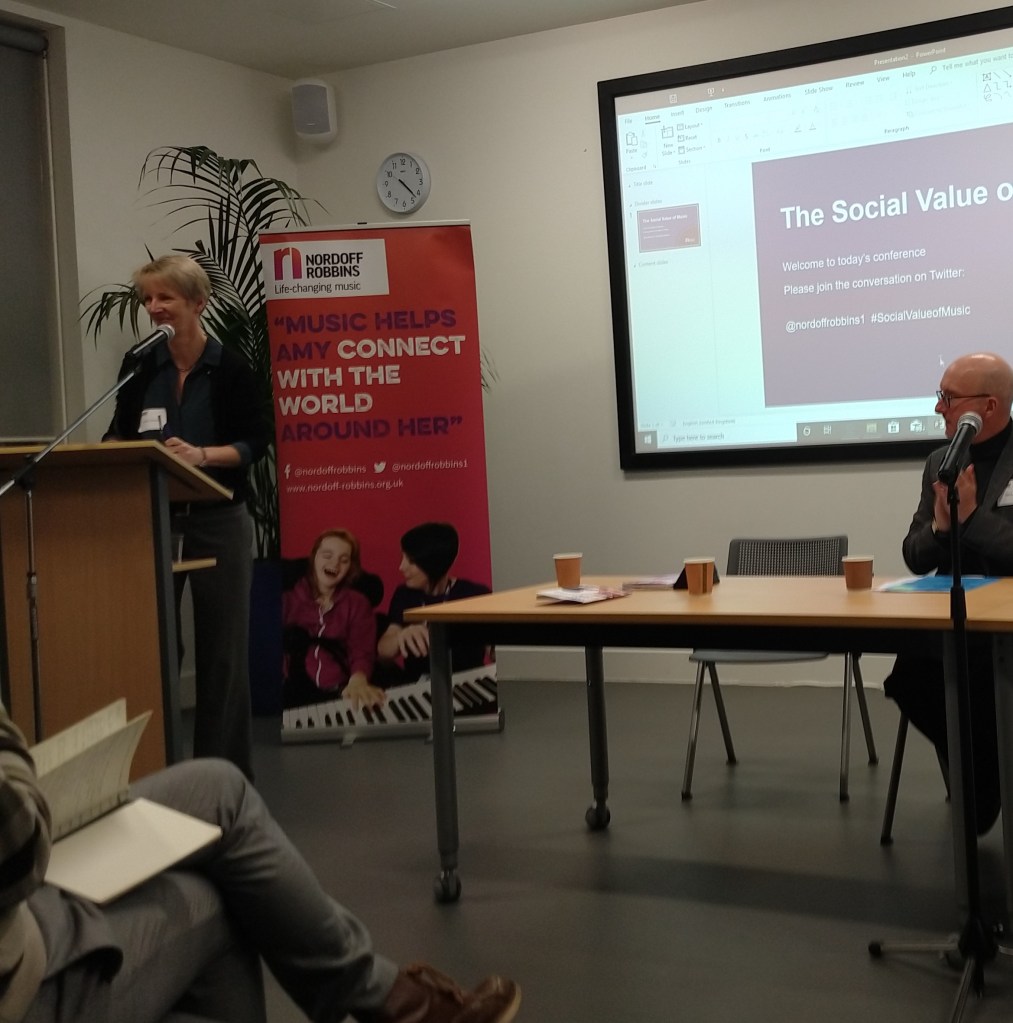
Over the last 15 years music therapists and community musicians have increasingly used the word ‘wellbeing’ to talk about their work. ‘Wellbeing’ – instead of the seemingly more ‘objective’ term, ‘health’. While the term wellbeing raises many complex issues, it also captures the multiple senses of what it means to be at ease, secure, or – the key (and deliberaely nebulous term) – flourishing. These things can, the thinking goes, stand side-by-side with physical symptoms or medically recognised ‘conditions’ and in ways that can actually affect those conditions – suppressing awareness of pain, perhaps even helping to reverse the mechanisms that contribute to, or cause, pain (and ‘total pain‘). This Nordoff Robbins conference examined how music often makes a crucial difference to how we live with illness or disability – with how we can still be ‘well’ within challenging circumstances, how music in short, can help.
Gary’s talk (‘When (exactly) is wellbeing? What clues does music therapy give?’), tackled a (research) question near to the heart of the Care for Music project – what level of research ‘focus’ is needed if we’re to move beyond merely general statements about how music helps? How can we begin (finally!) to specify the ecological web of what happens – musically and para-musically – that leads to increased ‘wellbeing’.
Former politician, and now CEO of UK Music, Michael Dugher talked about the macro-economics of the music business in this country and how we channel its power to bring music to everyone who needs it. Community musician and sociologist Prof Norma Daykin’s keynote challenged us to re-think what kind of enterprises music therapy and community music are. Are they professions or social movements? Provocative and useful thoughts …
Nottingham University: One of the sponsors was the Room 217 Foundation from Canada. The title of Gary’s talk was ‘Taking an improvisational attitude to music’s help’. He described how how music can foster second-by-second change (of energy, mood, intensity, movement, focus). Music practitioners can use improvisational methods in ways that create connection with (and between) people in challenging circumstances in care settings.
While there, Gary also did a research workshop with Dr Orii McDermott of Nottingham University’s Faculty of Medicine and Health Sciences – ‘Music therapy research in later life care settings: how can it help practitioners?’. So much research is being done now, but we still have to work hard to make sure that it reaches practitioners, who are the conduit for putting research into everyday contexts and in ways that further inform and develop the research. It’s a good sign that conferences where researchers and practitioners can meet – like this one at Nottingham – are happening, and happening more often.
Gary Ansdell at The Power of Music Conference Nottingham (photo: Raymond MacDonald)
Micro analysis of musical engagement takes time. It often dwells on split second interaction. The kind of things that, literally, if you blink, you will miss. Sometimes small things have large effects. In popular culture we speak of things like the ‘final straw’, of ‘tipping points’, of how sometimes things can, and have to ‘turn on a dime’. We know that details matter. In communication, and musical communication (or ‘communion’) these nuances can determine many so-called ‘larger’ things for example, the quality of the relationship between two or more people, their mutual perceptions of each other, their gradual and mutual attunment (or not) and their future conduct trajectories. The keynote talk described the importance of micro-ritual interactions in socio-musical situations of care and the kinds of differences that these ritual interactions can make for action and for opportunities for action in space and time.
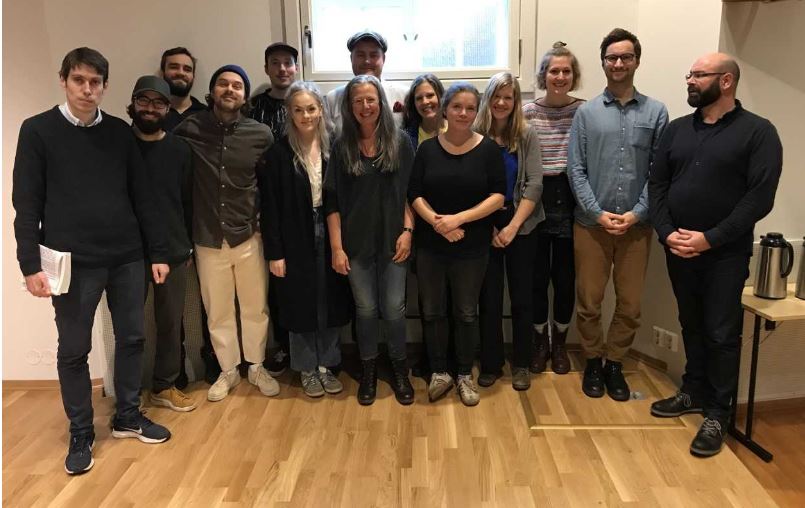
Frode Aass Kristiansen, Tia DeNora, Maren Metell, and Simon Gilbertson with the Masters Students in Music Therapy GAMUT
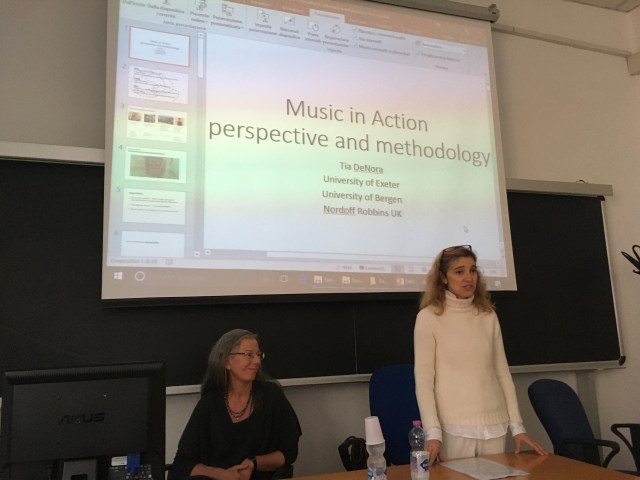
Memory Studies at University of Rome, III. Professoressa Annalisa Tota and her team at Roma III are specialists in ‘technologies of memory’, by which they mean cultural media. They study how memory is always collective – it takes shape in relation to available cultural images, narratives, and structured arrangements of sensory materials – such as music. They also study how memory is selective, how somethings are foregrounded, others backgrounded. This selectivity – including the question of what there is ‘to be remembered’ – is always political. It is often also Political. For example, Tota is especially interested in traumatic memories and in when what we know and how, at times what we know and/or remember, cannot be openly stated but needs to be coded aesthetically – as ‘fiction’, as ‘art’, as ‘music’. (see her magnificent article, “I know, but I have no proof”.) We presented some of the theoretical issues relating to music, action and time to a group of students and staff in December and this was followed by useful discussions about remembering, forgetting and the role of the arts, specifically music.
Two days discussing how to enrich our languages of death and dying, how to build responsive, sustainable, and creative communities of care (see photo of Nigel’s keynote below), volunteering, help/self help, and the importance of fleeting, often very tiny, acts of kindness between people. Death and dying, illness – these involve much more than the physical symptoms. They are characterised by total pain, and culture (music) has a role to play in the transfigurement of that kind of (psycho- social- physical- existential- ) pain. Lesson: dying is fundamentally social and death can be our friend. At the end of day one, the Mountbatten Choir lifted everyone’s spirits.



 Care for Music